
Online Wedding Philippines to USA: How to Get Married Online Through Utah
By Alexander Binder, founder of A.R.IMMIGREALTY, 27 years of legal practice abroad
An Online Wedding Philippines to USA can be a practical option for couples who live in different countries and want to formalize their relationship without arranging an international trip for the wedding ceremony. One partner may be living in the Philippines while the other is in the United States, Israel, or another country.
Utah’s remote marriage system is particularly interesting for international couples because the marriage license application and wedding ceremony can be completed remotely. In 2024 alone, roughly 5,316 people used this route while living in Israel — making it one of the most common cross-border marriage solutions used by foreign couples worldwide. The couple does not necessarily need to travel together to Utah simply to participate in the ceremony.
This makes an Online Wedding Philippines to USA relevant for Filipino-American couples, Filipino citizens whose partners live abroad, long-distance couples, and international couples who need an official marriage certificate for subsequent civil or immigration procedures. If your situation instead involves a partner from another Asian country, our Utah Wedding for Chinese Couples guide covers a very similar path.
However, there is an important distinction to understand from the beginning: getting legally married under Utah law and using that marriage certificate in another country are two separate legal questions.

Can You Have an Online Wedding from the Philippines to the USA?
Utah County provides an online marriage license system that is available to eligible applicants regardless of whether they are residents of Utah.
The process is particularly suitable for couples who cannot easily be in the same country. For example, one partner may be physically located in Manila, Cebu or another city in the Philippines while the other partner is living in the United States.
The couple can complete the marriage-license process remotely and participate in the wedding ceremony through video conference, provided all applicable Utah requirements are satisfied. Under Utah Code §81-2-305, which governs who may solemnize marriages and how remote appearance is authorized, the officiant’s own location — not the couple’s — is what makes the ceremony legally valid.
This means that an Online Wedding Philippines to USA does not necessarily require the Filipino partner to obtain a U.S. visa simply for the purpose of attending the Utah wedding ceremony. It is nevertheless important to distinguish marriage from immigration. A Utah marriage does not by itself give the foreign spouse permission to enter or reside in the United States.
Why Utah Is Used for International Online Weddings
Many jurisdictions still require the couple to appear physically before a marriage authority. Utah developed a digital marriage system that makes remote participation possible.
For international couples, the practical advantages can be significant. Instead of coordinating international flights, accommodation and time away from work, the partners can participate from their respective locations. The marriage itself is performed according to Utah law, while the participants communicate remotely.
How the Utah Online Marriage Process Works
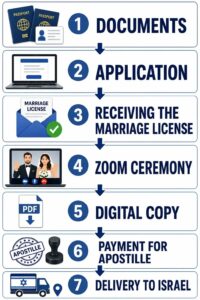
The process generally begins with an online marriage-license application. Both applicants provide the required personal information and complete the applicable identity-verification procedures.
Once issued, the Utah marriage license is valid for 32 days — the ceremony has to take place within that window, so timing the application matters as much as the paperwork itself.
For a remote ceremony, the couple participates by video conference with an authorized officiant and two adult witnesses. After the ceremony has been properly completed and recorded, an official Utah marriage certificate can be issued.
For international use, the couple may subsequently need an apostille under the HCCH Apostille Convention depending on the country where the certificate will be submitted.
Agency vs. Self-Filing: What Actually Differs
Some couples try to complete the Utah process entirely on their own. It’s possible — but three points tend to catch people off guard: the exact form format required for foreign documents, verifying the officiant’s authorization before the ceremony, and treating the apostille as a separate, easy-to-forget document rather than something that comes automatically with the certificate.
| Self-filing (DIY) | A.R.IMMIGREALTY | |
|---|---|---|
| Price | Utah state fees paid directly, plus your own time | ₪1,980, fully inclusive |
| Form/document review | Your responsibility | Checked before submission |
| Officiant verification | Your responsibility | Handled by the agency |
| Apostille as a separate step | Easy to miss | Included, tracked to completion |
| Support if something goes wrong | None built in | Direct support until certificate is issued |
Neither path is «wrong» — a simple, well-prepared case can go smoothly either way. The risk with DIY isn’t the process itself, it’s the small details (a form field, a witness requirement, the license’s 32-day clock) that are easy to miss the first time through.
Why the Price Doesn’t Mean Something Is Wrong
A fixed ₪1,980 for the full process — application, ceremony coordination, and apostille — understandably makes some couples pause. The price is low because there’s no flight, no hotel, no notary chain involved — the savings come from the process itself being remote, not from cutting corners. It’s worth checking any agency independently before paying anything: look at Google reviews, ask whether the marriage certificate and apostille are both issued by government bodies (which makes them difficult to falsify), and ask what happens, step by step, after payment. A.R.IMMIGREALTY has registered over 300 Utah marriages since March 2023, and the price has not increased since the service began.
What Do You Receive After the Wedding?
After the marriage has been solemnized and properly recorded, the couple can obtain an official Utah marriage certificate. On average, the apostilled certificate is in hand within about 30 days of the ceremony; full administrative closure — including registration with the relevant civil registry in the couple’s country of residence — typically takes 6 to 8 weeks in total.
For many international couples, this document is the primary reason for choosing a formal remote marriage rather than holding an informal online ceremony. But receiving the marriage certificate should not be regarded as the end of the international legal process. The couple must next determine where the document will be used.
Case: A Long-Distance Filipino-Israeli Couple
Marites, a caregiver from Manila working in Netanya, and Eitan, an Israeli she’d been with for two years, kept postponing the question of marriage — mostly because neither of them wanted to deal with the rabbinate, and a trip to Cyprus meant Marites losing paid work days she couldn’t spare. Her work visa had a renewal deadline coming up, and a recognized marriage would simplify her status review. They completed the Utah application and ceremony from her apartment on a Sunday evening — Eitan joined from his own home after his shift. The certificate and apostille arrived within the month, in time for her visa renewal appointment.
Is a Utah Online Marriage Recognized in the Philippines?
This question requires particular care. Philippine law contains rules concerning marriages celebrated outside the Philippines. Article 26 of the Family Code addresses marriages solemnized abroad and their validity in the Philippines, subject to statutory exceptions.
The broader legal logic behind cross-border marriage recognition has been examined in academic literature on private international law — see, for instance, the discussion of Israeli conflict-of-laws marriage recognition in the Brooklyn Journal of International Law, and the treatment of cross-border recognition of remote and online marriages, including Utah’s own remote-officiant model, in the European Journal of Law and Technology.
Couples should not convert a general recognition rule into an assumption that every remote marriage performed anywhere in the world will automatically be accepted for every purpose. Utah County itself advises international applicants to determine whether a marriage conducted through online remote appearance will be recognized in their country of residence.
Report of Marriage for Filipino Citizens
For Filipino citizens who marry abroad, the marriage needs to be reported to the Philippine Statistics Authority through a Report of Marriage (ROM), filed at the Philippine Embassy or Consulate with jurisdiction over the place where the couple resides (for couples in Israel, this is the Philippine Embassy in Tel Aviv). Typically required: the original apostilled Utah marriage certificate, the Filipino citizen’s passport, and a completed ROM form provided by the consular post. Processing times and any additional requirements vary by consular post, so couples should confirm current requirements directly with their embassy before submitting.
The fact that the wedding ceremony can be completed quickly online does not mean that subsequent civil-registration formalities disappear.
Filipino and U.S. Citizen: Does Online Marriage Give Immigration Status?
No. Marriage and immigration are related, but they are not the same legal process. A Filipino citizen does not automatically obtain a U.S. visa, permanent residence or permission to enter the United States merely because a marriage ceremony has taken place. U.S. immigration authorities apply separate immigration rules.
The wedding certificate is evidence of the marriage. It is not, by itself, an immigration visa.
What If the Other Partner Is Israeli Rather Than American?
This is particularly relevant for Filipino citizens living in or connected with Israel. A Filipino partner may be in the Philippines while the Israeli partner is in Israel — or both partners may already live in Israel but be unable or unwilling to marry through a religious institution.
The legal basis for accepting a foreign civil marriage in Israel did not appear overnight. It traces a single, continuous principle: Funk-Schlesinger v. Minister of Interior (1963) established that the population registrar has no authority to judge the substantive validity of a foreign marriage — only to register it based on the foreign public document; Ben-Ari v. Director of Population Registry (2006) applied the same registrar-only-records logic to same-sex marriages performed abroad; and the 7 March 2023 ruling (עע»ם 7368/22, Ministry of Interior v. Bril) reapplied that same principle to marriages concluded by remote appearance, confirming that a Utah Zoom ceremony is treated the same way as any other foreign civil marriage.
A Filipino-Israeli couple’s route typically looks like this:
online marriage application → Utah Zoom ceremony → marriage certificate → apostille → presentation of the foreign marriage documentation in Israel → separate foreign-spouse status procedure where applicable. For the immigration side of that last step, our guide on obtaining an Entry Visa for Spouse or Partner to Israel walks through the documentation involved.
Marriage Does Not Automatically Give Israeli Citizenship
Just as marriage to an American does not automatically create U.S. immigration status, marriage to an Israeli does not instantly grant Israeli citizenship to the foreign spouse. Israel has a separate administrative procedure for regulating the status of a foreign spouse, examining documentation concerning the relationship, marital status, center of life and other relevant circumstances.
Timeline at a Glance
| Stage | Typical duration |
|---|---|
| Marriage license validity | 32 days |
| Ceremony to certificate in hand (apostilled) | ~30 days |
| Full administrative closure (registration abroad) | 6–8 weeks |
| Israelis married via Utah in 2024 | 5,316 |
Common Mistakes Before an International Online Wedding
The first mistake is focusing entirely on the ceremony while ignoring what happens afterward. The second is assuming that marriage automatically determines immigration status — it does not. The third is failing to check the spelling of names and other identifying information. The fourth is ordering documents without determining whether an apostille will be required. The fifth is assuming that because a marriage is validly documented in one jurisdiction, every other jurisdiction must automatically treat it identically for every legal purpose.
Couples exploring alternatives before settling on Utah sometimes also compare it against destination weddings — our overview of Weddings Abroad lays out why most of those routes ended up more expensive and logistically heavier than the remote option.
How A.R.IMMIGREALTY Can Help
For couples who would rather not navigate the license window, witness rules and apostille chain alone, A.R.IMMIGREALTY handles the full process — application, ceremony coordination, and apostille — for a fixed all-inclusive fee of ₪1,980, with no add-on charges at any stage. The agency has registered over 300 online Utah marriages since March 2023 and operates 24/7. You can reach the team directly at tel:+972542150724.
Frequently Asked Questions
Can I marry someone in the USA while I am in the Philippines?
Utah’s remote marriage system can permit eligible couples to participate from different physical locations. The couple should separately verify the legal and immigration consequences relevant to the countries involved.
Do I need a U.S. visa to have a Utah online wedding?
Physical travel to Utah is not inherent in the remote ceremony process. A marriage, however, does not itself create permission to enter the United States.
Can both partners be outside Utah?
Yes — the Utah County remote marriage system is designed to accommodate remote participation from anywhere, subject to its requirements.
Can an Israeli marry a Filipino through Utah online?
Eligible foreign applicants can use the Utah system. The resulting marriage documentation and subsequent Israeli registration or foreign-spouse procedure are separate matters.
Do we need witnesses?
Yes. Two adult witnesses are required, and for a remote ceremony they may participate through the video conference when applicable requirements are met.
Will we receive an official marriage certificate?
Yes — after the marriage has been properly solemnized and recorded, official Utah marriage documentation can be issued, typically in hand within about 30 days.
Do we need an apostille?
That depends on where the certificate will subsequently be used. International use of the marriage certificate commonly requires appropriate authentication, and an apostille may be required in countries using the Hague Apostille system.
Is the apostille proof that another country recognizes the marriage?
No. Authentication of a public document and the legal recognition or registration of marital status are different issues.
How does a Filipino citizen report the marriage back home?
Through a Report of Marriage filed with the Philippine Embassy or Consulate with jurisdiction over the couple’s place of residence, along with the apostilled certificate and passport.
Is a licensed agency more expensive than doing it alone?
Not necessarily — self-filing has no agency fee, but the risk is in the details (forms, witness rules, the 32-day license window), not the price.
Planning an Online Wedding Philippines to USA
An Online Wedding Philippines to USA can solve one significant problem for an international couple: the need to be physically together in the United States simply to conduct the marriage ceremony. Before proceeding, couples should consider where the marriage certificate will be used, whether an apostille is necessary, whether civil registration is required, and whether a separate immigration or foreign-spouse procedure will follow.
Тут связь с флагманом уже есть, нужно только добавить связь со страницей 2 вместо Cyprus:
🟩 Online Marriage in Utah for Filipino and Thai Citizens
🟩 Utah Online Marriage Philippines: How Filipino Couples Can Marry Online in 2026
🟩 Contact A.R.IMMIGREALTY
How to Time and Prepare for an Online Wedding Philippines to USA
Couples researching an Online Wedding Philippines to USA often get the legal part right and then stumble on something much more mundane: scheduling. A ceremony that takes fifteen minutes on Zoom still has to happen at a specific hour, with two people, two witnesses, and one officiant all logged in and ready — and when your Online Wedding Philippines to USA spans a twelve-to-fifteen-hour time difference, that’s not as simple as it sounds.
Working Around the Time Difference
Manila sits roughly twelve hours ahead of Utah during standard time, and thirteen during daylight saving. For an Online Wedding Philippines to USA, that usually means one partner is joining first thing in the morning while the other is finishing dinner the night before — or vice versa. Officiants who specialize in remote ceremonies are used to this. Most keep evening and early-morning slots specifically to accommodate couples doing an Online Wedding Philippines to USA or a similar cross-Pacific arrangement.
The practical advice here is simple: book the ceremony slot before locking in anything else. Once you know the exact ceremony time, you can plan around it — work shifts, family attendance, even a small celebration afterward — rather than the other way around. Couples who leave scheduling for last often find their preferred time already taken, especially around weekends, which is when most people planning an Online Wedding Philippines to USA tend to request their ceremony.
What the Ceremony Actually Looks Like
An Online Wedding Philippines to USA is not a symbolic gesture dressed up as a legal event — it is the legal event. The officiant opens the video call, confirms the identities of both parties and both witnesses, and proceeds through the same declarations used in any Utah marriage ceremony. It typically runs ten to fifteen minutes. Couples sometimes expect something closer to a livestreamed wedding, with music and readings; in practice, an Online Wedding Philippines to USA is closer in tone to a courthouse ceremony — brief, procedural, and legally binding the moment it concludes.
That doesn’t mean it has to feel cold. Nothing prevents the couple from dressing formally, decorating the room behind them, or inviting family members to watch on a separate call. Many couples doing an Online Wedding Philippines to USA treat the ceremony itself as the legal formality and plan a separate celebration — sometimes months later, once both partners are physically together — for the part that feels like a wedding.
Choosing Witnesses Across Two Countries
One detail that trips people up: witnesses for an Online Wedding Philippines to USA don’t have to be in the same country as either partner, or even in the same country as each other. Utah’s remote-ceremony framework allows witnesses to join by video conference from wherever they happen to be, as long as they are adults and can be clearly identified on camera.
For a Filipino partner in Manila, this often means a sibling or close friend joining from a phone at home. For the partner abroad, it might be a colleague or neighbor. The one thing worth checking in advance: a stable internet connection. More ceremonies get delayed by a dropped video call than by any documentation issue — which is a fairly low-tech problem to have derail something as significant as an Online Wedding Philippines to USA.
Naming and Document Consistency
If your Online Wedding Philippines to USA is meant to lead somewhere — a visa application, a Report of Marriage, a change of surname — the small details matter more than they seem to at the time. Philippine documents sometimes render names differently than a U.S. or Israeli passport does, particularly with middle names, hyphenation, or diacritical marks. Before applying for the license, both partners should compare exactly how their names appear across every document they plan to use later. Fixing a discrepancy after the certificate is issued is considerably more work than catching it beforehand.
Building in a Buffer
The Utah marriage license carries a 32-day validity window once issued, and the ceremony has to fall inside it. For couples planning an Online Wedding Philippines to USA around a specific deadline — a visa expiry, a work contract renewal, a planned relocation — it’s worth applying early enough to leave a real buffer. Officiant availability, document review, and the occasional technical delay all eat into that window faster than people expect.
Couples in a similar situation but working with a different nationality pairing sometimes find it useful to compare notes with other cross-border Utah cases involving Asian partners — the scheduling and documentation issues tend to repeat across countries, even when the specific legal recognition questions differ.
After the Call Ends
The moment the officiant confirms the marriage, an Online Wedding Philippines to USA is legally complete — even though the physical certificate hasn’t arrived yet. This is a point of real anxiety for some couples: nothing tangible exists yet, just a video call that ended. It’s worth remembering that the certificate itself is a record of something that already happened, not the event that makes it happen. The marriage is valid from the moment of the ceremony; the paperwork simply catches up over the following weeks.
For couples juggling the Philippines, the United States, and sometimes a third country like Israel, an Online Wedding Philippines to USA removes the single biggest obstacle — being in the same place at the same time — without removing the need to plan carefully around everything that comes before and after that one short video call.
What Changes After an Online Wedding Philippines to USA
Once the ceremony is over and the certificate is on its way, most couples assume the hard part of an Online Wedding Philippines to USA is behind them. In one sense it is — the legal act is complete. But an Online Wedding Philippines to USA also opens a set of smaller, practical questions that tend to surface over the following weeks and months: what happens to insurance, taxes, a surname, or eventually, children. None of these are complicated on their own, but they’re easy to overlook in the excitement of finishing the ceremony itself.