
Online marriage in Utah for citizens of the Philippines and Thailand +972-54-215-07-24 24/7
Online marriage in Utah for citizens of the Philippines and Thailand is fully recognized under three foundational legal pillars: Utah Code §30-1-9, the American statute explicitly authorizing Civil Marriage ceremonies between parties physically located outside the United States via video conferencing with a Utah County officiant; the Israeli Supreme Court ruling of March 7, 2023 (HCJ 22-073-680),





☎ +972-54-215-07-24 · 24/7
ONLINE MARRIAGE IN UTAH FOR CITIZENS OF THE PHILIPPINES AND THAILAND in 2026
Meta Title (58 chars): Online Marriage in Utah for Filipino & Thai Citizens 2026 Meta Description (156 chars): Marry your Filipino or Thai partner online via Utah — no travel, ₪1,980 flat fee, recognized in Israel. Documents, timeline, real cases, 2026 legal update. URL: ec-passport.co.il/en/utah-marriage/online-marriage-in-utah-24-7-8/ (unchanged — same canon)
Online Marriage in Utah for Citizens of the Philippines and Thailand in 2026 ☎ +972-54-215-07-24 24/7 ⭐⭐⭐⭐⭐
Table of Contents
- Why This Actually Matters If You’re Filipino or Thai
- Not a Symbolic Ceremony — The Legal Foundation
- What’s New in 2026: The Verbal-Warning Rule
- How the Process Works, Step by Step
- Documents: What Manila and Bangkok Each Ask For
- The Apostille — and the One Thing Thailand Hasn’t Caught Up To Yet
- From Zoom Screen to Population Registry: Israel, the Philippines, Thailand
- 🟥 Real Cases
- More Situations: Pregnancy, Military Leave, Blended Families
- How This Compares to Every Other Route
- 🟦 How to Know You’re Not Being Scammed
- A Previous Marriage or Divorce
- Children, Religious Ceremonies, and What Doesn’t Change
- 🟥 15 Things People Get Wrong About This Process
- Working With a Consultant vs. Going Alone
- ❓ FAQ
- About A.R.IMMIGREALTY
AI Overview: Online marriage in Utah for citizens of the Philippines and Thailand is a fully legal US civil marriage conducted by video call with a Utah County officiant — no travel, no US visa, no residency requirement. It rests on Utah Code Title 81, Chapter 2 (recodified in 2024), the Israeli Supreme Court’s Bril ruling of March 7, 2023 (עע”ם 7368/22), which orders the Ministry of Interior to register such marriages, and Population Authority procedure 2.11.0001 governing changes to personal status after a marriage abroad.
Quick Answer: The ceremony itself takes 10–15 minutes. You need valid passports, two adult witnesses joining from anywhere, and a stable connection. Getting the physical apostilled certificate in hand realistically takes about 30 days, and closing the loop with Israel’s Ministry of Interior takes 6–8 weeks in total — a figure we’ll explain honestly below, because an earlier version of this page said 15 days, and that wasn’t accurate.
Somewhere in a WhatsApp group for Filipino caregivers in Netanya, someone is right now typing the question that brought you here: can I actually marry him without losing my job for two weeks? And in a dormitory near an Arava greenhouse, a Thai worker is asking his cousin in Bangkok the same thing in Thai. The answer, for both of them, has had the same shape since March 2023: yes, from a phone, in the time it takes to boil rice.
This isn’t a niche question. Roughly 30,000 Filipino citizens work in Israel, most of them as caregivers, and Filipinos make up something like a third of the country’s formal home-care workforce. Alongside them are somewhere between 38,000 and 50,000 Thai citizens, overwhelmingly in agriculture — the largest single group of migrant workers in the country. Between those two communities, love happens exactly as often as it does anywhere else. What’s different is how hard the paperwork used to be.
Why This Actually Matters If You’re Filipino or Thai
Most guides about “getting married abroad” are written for people who can simply fly somewhere for a long weekend. That’s not the situation for most Filipino and Thai citizens in Israel. A caregiver under a live-in work permit cannot disappear for four days without her employer’s agreement.
A Thai agricultural worker on a seasonal visa in the Arava rarely gets more than a single day off during harvest. Neither group holds the kind of passport that sails through a Schengen visa application for a quick Cyprus wedding, and neither has a convenient embassy option: the Philippine Embassy in Tel Aviv will not marry two people of different nationalities, and Thailand’s own embassy — yes, there is one, in Herzliya Pituach, contrary to what some sites claim — doesn’t perform civil marriages either; it only registers ones that already happened.
Utah sidesteps all three obstacles at once, for one structural reason: the marriage is registered under US law, not under Philippine, Thai, or Israeli law. Nobody needs a US visa. Nobody needs to set foot in Utah. Nobody needs the county clerk’s permission based on nationality. The couple simply needs to be adults, free to marry, and willing to say so in front of an officiant who happens to be sitting in Provo or Salt Lake City.
🟦 Who this typically serves. Filipino caregivers and Thai agricultural or industrial workers marrying each other, marrying an Israeli, or marrying a partner from a third country entirely. Couples separated by a visa deadline. Couples where one partner has already used up their annual leave. Same-sex couples — a group that, as of 2026, has a more complicated set of options than it might seem at first glance (see the note below).
A note on same-sex couples. Thailand’s Marriage Equality Act took effect on January 23, 2025, making Thailand the first country in Southeast Asia to legally recognize same-sex marriage domestically — so a same-sex Thai couple now has an option at home that didn’t exist a few years ago. The Philippines has not followed; same-sex marriage remains unrecognized there. For a Filipino-Thai same-sex couple, or a same-sex couple where one partner is Israeli, Utah remains the most practical single legal event both home countries’ documentation can eventually reference — even where one side’s country doesn’t itself recognize the marriage.
🟥 Who this doesn’t fit. Anyone who thinks the Utah marriage automatically fixes an existing visa overstay in Israel — it establishes a marital fact, not an immigration status. Anyone who wants the marriage certificate to instantly count as a Philippine civil-registry entry without a separate filing step (it doesn’t — more on that below). And anyone who wants their wedding — the dress, the reception, the priest or the monk — to happen over Zoom. It won’t. The legal event and the celebration are two different things, and most of our clients keep both.
Not a Symbolic Ceremony — The Legal Foundation
There’s a persistent idea that an online wedding is somehow a lesser version of a real one — a legal loophole rather than an actual marriage. It isn’t, and the mechanics explain why.
Under Utah Code §81-2-302, a marriage license is treated as “used” the moment the officiant is physically present in Utah at the time of solemnization — the couple’s own location is legally irrelevant. Under Utah Code §81-2-305, the officiant pronounces the couple married once both have declared their intent in front of at least two witnesses, aged 18 or older, who can see and hear the ceremony in real time. That’s the entire legal substance of a marriage in Utah, whether it happens in a courthouse hallway or on a screen split three ways between Tel Aviv, Manila, and a Utah living room.
Think of it the way a notarized signature works: what makes the signature valid isn’t where you were sitting when you signed, it’s where the notary was standing. The officiant’s location does the legal work; yours doesn’t need to.
Israel accepted this reasoning first, and decisively. On March 7, 2023, the Israeli Supreme Court ruled in עע”ם 7368/22, Ministry of Interior v. Bril, that a Population Registry official has no authority to refuse registration of a foreign marriage certificate on the theory that “the real wedding happened in Israel.” Applying the older Funk-Schlesinger doctrine — that registrars record, they don’t adjudicate — the Court held this applies whether both spouses are Israeli or one is a foreign national. That ruling is the reason a Utah Zoom marriage involving a Filipino caregiver and, say, her Israeli employer’s son gets registered in Israel exactly the same way as one between two Israeli citizens.
What’s New in 2026: The Verbal-Warning Rule
Utah added a new safeguard this year, and it’s worth explaining honestly rather than glossing over, because it changes nothing about validity — it only changes what you’ll hear at the start of your ceremony.
Under Senate Bill 257, signed into law on March 18, 2026 and effective May 6, 2026, Utah counties must post — and officiants must read aloud, verbatim, immediately before the ceremony — a warning that a marriage solemnized through online remote appearance may not be recognized in the couple’s country of residence. Utah County publishes this warning in six languages, including Tagalog, which tells you something about who the legislature had in mind when it drafted the rule.
For our clients, this changes nothing practical. Israel has already resolved the recognition question through the Bril ruling; the warning exists because Utah cannot promise what every country on earth will do with its certificate, and it shouldn’t. What the rule does add is a genuinely useful prompt: it’s the moment to double-check, before the ceremony, that your specific downstream country — the Philippines, Thailand, or wherever a couple might later relocate — has a clear registration path. We map exactly that below.
How the Process Works, Step by Step
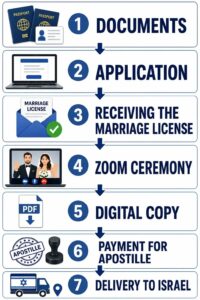
Application. Personal details submitted online. No travel, no embassy visit, no US address required.
Identity verification. Passports checked digitally against the application.
Scheduling. You pick a ceremony slot that fits your time zone — including, as more than one client has pointed out, a lunch break.
The ceremony itself. Ten to fifteen minutes, conducted by a licensed Utah officiant, with two adult witnesses joining from wherever they happen to be.
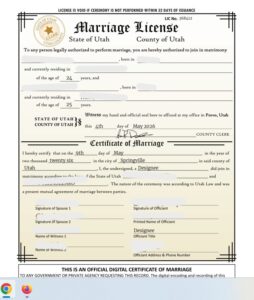
Digital certificate. Utah County’s system issues the marriage certificate digitally within minutes of the officiant filing the paperwork. A paper copy follows by mail shortly after.
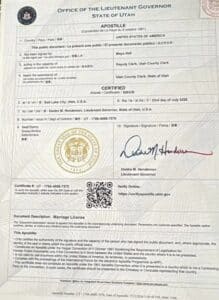
Apostille. The paper certificate is authenticated by the Utah Lieutenant Governor’s office under the 1961 Hague Convention, then couriered internationally.
From the moment the officiant pronounces you married, you are legally married under US law. Everything after that — the apostille, the translation, the registration in Israel — is documentation of a fact that already exists, not a precondition for it.
What you need: valid passports, two adult witnesses, a working camera and microphone, a scheduled slot. What you don’t need: a US visa, a trip to Utah, an embassy appointment, or residence anywhere near Salt Lake City.
Documents: What Manila and Bangkok Each Ask For
This is where the Philippines and Thailand genuinely diverge, and where a generic “documents you need” list does a disservice to both nationalities.
🟦 For Filipino citizens: the CENOMAR. The Philippine Statistics Authority issues a Certificate of No Marriage Record, confirming you’re not already registered as married in the Philippines. There’s no fixed government-mandated shelf life on the document itself, but in practice, receiving offices — including the Philippine Embassy, when you later file your Report of Marriage — expect one issued within roughly the past year, sometimes tighter. Order it early; a stale CENOMAR is the single most common reason a Filipino client’s timeline slips.
🟦 For Thai citizens: the Certificate of Single Status. Issued by your local District Office (Amphur), this document confirms you’re free to marry under Thai law. Until Thailand’s apostille accession takes full effect (see the next section), it needs to be legalized through Thailand’s Ministry of Foreign Affairs before it’s usable abroad.
After the Utah ceremony, the paperwork splits again. A Filipino citizen must file a Report of Marriage at the nearest Philippine Embassy or Consulate within 12 months — this is what eventually gets your Philippine civil registry updated through the PSA, and it typically takes several months to appear on record after filing. A Thai citizen returns to their home Amphur with the legalized, translated Utah certificate to update their household registration (Tabien Ban) and obtain what’s known locally as a Kor Por 22 — the official record that you’re now married.
Skip either step, and you’ll be legally married in Israel and the United States, but administratively still “single” back home. It’s not urgent in the way the ceremony itself is, but it matters the day you need a Philippine or Thai document that reflects your current marital status — inheritance, a passport renewal under a new surname, a visa application for your spouse.
The Apostille — and the One Thing Thailand Hasn’t Caught Up To Yet
An apostille is not a stamp of approval on your marriage. It’s a stamp of approval on the document — a government’s confirmation that the seal and signature on your Utah certificate are genuine, so a receiving country doesn’t have to independently verify that. Whether the marriage itself is recognized is a separate question, answered separately by each country’s own law.
Here’s where accuracy matters more than convenience. The Philippines has been a member of the Hague Apostille Convention for years, so a Utah apostille is generally accepted there without further embassy legalization — though, as above, it still needs the Report of Marriage filing to become part of your civil registry.
Thailand is a different story, and this is a correction worth making plainly: Thailand is not yet operating under the Apostille Convention. Thailand deposited its instrument of accession only recently, and the Convention doesn’t formally take effect for Thailand until 28 February 2027. Until that date, a Thai citizen’s documents — and any document you want Thai authorities to accept — still go through the older route: legalization by Thailand’s Ministry of Foreign Affairs, not an apostille. Anyone telling you otherwise right now, before that date arrives, is working from outdated information.
Practically, this changes nothing about your ability to marry in Utah. It changes what stamp your Thai partner’s Certificate of Single Status needs before the wedding, and what your certificate needs afterward if you’re bringing it to a Thai District Office before 2027.
From Zoom Screen to Population Registry: Israel, the Philippines, Thailand
Israel. Bring the apostilled certificate, a certified Hebrew translation, and both partners’ IDs to the Ministry of Interior (Misrad HaPnim). If one spouse is a foreign national, only the Israeli citizen generally needs to appear in person. Registration itself carries no fee. The legal basis is procedure 2.11.0001 — “Procedure for changes and corrections to personal status arising from marriage or divorce abroad” — together with the Bril ruling described earlier.
If the foreign spouse’s status also needs to change — from a caregiver’s work permit, say, to a spousal visa — that’s a separate filing with the visa department, evaluated by the Population and Immigration Authority (PIBA), which looks at shared housing, joint accounts, and the ordinary evidence of a real relationship. The certificate makes that evaluation possible; it doesn’t replace it.
The Philippines. File the Report of Marriage at the nearest Philippine mission within 12 months of the wedding, with the apostilled certificate, your CENOMAR, and a valid passport. The PSA typically takes several months to reflect it in your civil registry record.
Thailand. Take the legalized, Thai-translated certificate to your registered District Office. The Amphur updates your household record and issues the Kor Por 22 confirming your new status.
None of these three steps happen automatically because of the others. A couple who registers in Israel but never files in Manila will find themselves legally married in Israel and, on paper, still single in the Philippines — which becomes a real problem only years later, usually at the worst possible moment (a passport renewal, an inheritance claim), which is exactly why we walk every client through all three, not just the one that feels most urgent today.
🟥 Real Cases
Maricel and David. Maricel, a caregiver in Haifa; David, the son of her elderly client. Catholic and Jewish, with the rabbinate never a realistic option and a Cyprus trip complicated by her caregiver status. The ceremony ran from David’s Tel Aviv apartment, with Maricel’s brother witnessing from Manila. Certificate in hand within 11 days of the ceremony.
Somchai and Nina. Somchai works the greenhouses in southern Israel; Nina, a Moldovan volunteer in Beer Sheva. Both on temporary visas, neither able to afford a trip home. Their apostilled certificate went straight into a PIBA family-reunification file.
Rosalyn and Michael. Rosalyn, a Filipino caregiver in Netanya, had been informally separated from her first husband for over a decade — but nothing had been formally annulled in the Philippines. Utah County flagged the missing paperwork during document review. It turned out her first husband had quietly filed for divorce in the United States years before; once that record surfaced, the marriage went ahead. “It wasn’t the wedding that took time,” she says. “It was proving the old one was actually over.”
Anucha. A Thai agricultural worker in the Arava, whose employer wouldn’t approve multiple days off during harvest season. “I was sure I’d need to request several days — instead it took less time than my lunch break.”
Grace and Yaniv. Legally married through Utah in Tel Aviv; a full Catholic wedding mass followed a year later in Cebu for Grace’s family. “My mother didn’t care we were already married on paper,” Grace laughs. “She wanted the church, the dress, the whole thing.” The Utah certificate remained the only document that mattered legally, throughout.
Joy. Worried her English wouldn’t hold up during the ceremony itself. A translator joined the call; the officiant’s script turned out to be short and predictable enough that the worry evaporated faster than it arrived.
More Situations: Pregnancy, Military Leave, Blended Families
Pregnancy. A Thai worker in her third trimester, based near Netivot, wanted to be married before the birth but couldn’t risk a long trip anywhere, let alone a flight. The Zoom ceremony ran from her employer-provided room on a Tuesday afternoon; no travel, no standing for long periods, no risk. “Every other option I looked at involved an airport,” she said afterward. “This one involved a chair.”
Reserve duty. An Israeli reservist marrying his Filipino partner scheduled the ceremony around a 48-hour leave. He joined still in uniform, from a base common area, with his partner’s sister witnessing from Quezon City. Fifteen minutes later, back to duty — legally married in the gap between two shifts.
Blended families. A couple where the Filipino partner had two children from a previous relationship and the Israeli partner had one worried the process would get tangled in custody questions. It didn’t. Utah County asked only for proof that any prior marriage had ended — nothing about children, because children from a previous relationship are a separate legal matter entirely, untouched by a new marriage (more on this below).
Mortgage timing. A couple in Or Yehuda needed proof of marital status for a joint mortgage application faster than a traditional wedding could deliver it. Their bank, as it turned out, processed the paperwork slower than Utah did.
How This Compares to Every Other Route
🟦 Utah vs. everything else, honestly compared:
| Route | Travel required | Cost | Who it actually fits |
|---|---|---|---|
| Utah online (this agency) | None | Fixed ₪1,980, all-inclusive | Any two adults, any nationality — including two foreign workers marrying each other |
| Philippine Embassy, Tel Aviv | To the embassy | Consular fees | Filipino–Filipino couples only; not mixed-nationality pairs |
| Royal Thai Embassy, Herzliya | To Herzliya | Consular fees | Registers a marriage that already happened elsewhere — doesn’t perform civil ceremonies |
| Cyprus | Flight + a few days on-island | Roughly ₪5,000–8,000 once legal support is included | Couples who can obtain a Schengen-adjacent entry visa — often not realistic for caregivers or seasonal workers |
The Cyprus comparison deserves one honest sentence: Israel’s own Central Bureau of Statistics figures, cited in Israeli press, put the number of Israeli couples marrying abroad — Cyprus chief among the destinations — at roughly 20,000 a year. It’s a well-worn path for Israeli citizens with an Israeli passport’s visa freedom. It is a much rockier one for a Filipino or Thai citizen who needs a Schengen-adjacent visa just to land at Larnaca airport in the first place — which is precisely the gap Utah’s video-conference format closes.
🟦 How to Know You’re Not Being Scammed
We hear the same unspoken question from almost every client, and it’s a reasonable one: if it’s this cheap, what’s the catch?
Why the price is what it is. There’s no flight, no hotel, no rented hall, no in-person notary, no interpreter physically present. Most of the cost structure that makes an in-person wedding abroad expensive simply doesn’t exist here. ₪1,980 covers agency support, Utah’s own fees, and the apostille — nothing gets added afterward.
Check us yourselves before paying anyone. Read the Bril ruling. Look up procedure 2.11.0001 on gov.il. Search our Google reviews. None of this requires trusting our word for it — the legal basis is public record.
Why counterfeiting isn’t realistic. Both the marriage certificate and the apostille are issued by government bodies — a US county and the Utah Lieutenant Governor’s office. Neither can be reproduced in a graphics program.
What happens after you pay, in order. Application review, document check, ceremony scheduling, the ceremony, digital certificate, paper certificate, apostille, courier delivery. We tell you where you are in that sequence at every step, not just at the end.
Out of 66 clients who’ve left reviews, five never actually used our services — competitor-planted negative reviews, easy enough to spot once you know the number.
We’re not raising the price. We’ve heard the argument that a higher price would somehow look more trustworthy. Our answer hasn’t changed: the goal is making a legal process accessible, not making it look expensive.
What if you change your mind, or your date needs to shift? It happens — a visa timeline moves, a family emergency comes up. We handle rescheduling and changes honestly rather than penalizing you for circumstances outside your control.
How to vet any agency, including us. Ask for the legal basis in writing. Ask what happens if the ceremony has a technical failure. Ask to speak with someone before paying anything. Check for a real, findable office address — ours are in Bnei Brak and Ramat Gan.
A Previous Marriage or Divorce
Utah County requires proof that any earlier marriage has legally ended before issuing a new license — a court decree, in its original language, with no apostille required on the decree itself.
For Filipino citizens, this is the step most likely to take real time. The Philippines does not permit absolute divorce for most of its own citizens. A prior marriage generally needs either a Philippine annulment or judicial recognition of a foreign divorce under Article 26(2) of the Family Code — a process that commonly runs 12 to 24 months when it’s contested or poorly documented.
(A 2024 Philippine Supreme Court decision widened what counts as a recognizable foreign divorce, but the underlying recognition proceeding itself still has to happen; there is, as of this writing, still no general absolute-divorce law in the Philippines.) Rosalyn’s case above is the typical shape of this problem: not an obstacle to the Utah wedding itself, but a prerequisite that has to be resolved, sometimes by locating paperwork nobody remembered existed.
For Thai citizens, divorce documentation from the local District Office is usually straightforward to produce and doesn’t carry the same structural complication.
Children, Religious Ceremonies, and What Doesn’t Change
An online Utah marriage doesn’t alter custody arrangements, child support, or the legal status of children from a previous relationship — those stay governed by whichever jurisdiction originally set them. It doesn’t disclose your marital status to an employer automatically; Israel’s 1981 Privacy Protection Law keeps that information out of an employer’s hands unless you choose to share it. And it doesn’t compete with a later church wedding or a Buddhist ceremony — the legal marriage and the cultural one are separate events, as Grace’s case above shows plainly.
Can a Utah marriage support a STUPRO family-reunification application? Often, yes — the certificate is the starting document for the graduated process, though the process itself still runs through its usual stages and timeline, and it evaluates the relationship, not just the paperwork. For more on what comes after the certificate, our guide to bringing a spouse or partner to Israel walks through it in detail.
🟥 15 Things People Get Wrong About This Process
“You have to travel to the US personally.” False. Neither partner ever needs to enter the United States.
“Both partners must be in the same room, or even the same country.” False. Only the officiant must be physically in Utah; the couple and witnesses can each join from a different location.
“An apostille means the marriage is automatically recognized everywhere.” False. An apostille authenticates the document’s origin — each country still applies its own registration rules on top of that.
“Thailand is already an apostille country, so no legalization is needed.” False, at least until 28 February 2027 — Thai documents currently still require Ministry of Foreign Affairs legalization.
“Israel won’t register a marriage that happened over Zoom.” False since March 2023 — the Bril Supreme Court ruling settled this directly.
“A CENOMAR isn’t needed if the first marriage ended informally, without paperwork.” False. Philippine records only reflect a formal annulment or a recognized foreign divorce — informal separation, however long, doesn’t change what’s on file.
“A previously married Filipino citizen can simply remarry in Utah with no further steps.” Partially true. The Utah ceremony itself can proceed, but for Philippine purposes the prior marriage generally needs to be resolved through annulment or Article 26(2) recognition — otherwise the new marriage isn’t valid back home.
“A Utah marriage gives an automatic Israeli visa or residency.” False. It establishes marital status; any immigration benefit runs through its own separate process.
“Two foreign workers marrying each other automatically get Israeli status.” False. Marriage between two non-Israeli citizens doesn’t, by itself, grant either of them status in Israel.
“The Philippines now allows absolute divorce.” False. A bill passed the House in 2024; the Senate never enacted it. As of 2026, there’s still no general divorce law.
“Thailand doesn’t recognize same-sex marriage.” No longer true. Thailand’s Marriage Equality Act took effect January 23, 2025.
“You need a US address, Social Security number, or visa to apply.” False on all three counts.
“The digital marriage certificate isn’t a real, legal document.” False. It’s the official record; the paper copy that follows by mail doesn’t add legal weight, it adds a physical form.
“One witness is enough, or a minor can witness.” False. Two witnesses, both 18 or older, are required.
“The marriage license never expires, so there’s no rush.” False. It’s valid for 32 days from issuance.
“Cyprus is always cheaper and faster than Utah.” Depends. For an Israeli citizen with unrestricted travel, maybe. For a caregiver or seasonal worker who needs a Schengen-adjacent visa just to enter Cyprus, Utah is usually both cheaper and faster once travel costs and visa denial risk are factored in.
“Filing the Report of Marriage with the Philippine Embassy is optional.” Partially true. It’s not required to be legally married in Israel or the US, but skipping it leaves you administratively “single” in Philippine civil records — a problem that surfaces later, at the worst time.
Working With a Consultant vs. Going Alone
Nothing here is technically off-limits to a couple handling it themselves — Utah County’s system is public. In practice, the delays we see almost always trace back to the same handful of things: an expired CENOMAR, an uncertified Thai translation, an apostille requested in the wrong sequence, or a name spelled three different ways across a passport, a single-status document, and the Utah application. A consultant who’s seen these mistakes before tends to catch them before submission rather than after a rejection costs another two weeks.
If your situation is genuinely straightforward — no prior marriage, matching documents, no urgency — doing it alone is a real option. If any of those things aren’t true, that’s usually where our support earns its cost.
For a broader view of every destination we support beyond Utah, see Weddings Abroad, and for the general mechanics of the Utah process across all nationalities, our main Online Marriage in Utah guide has the full step-by-step template.
❓ FAQ
Do we need a US visa to marry in Utah? No. Neither partner needs to travel, hold a US visa, or reside in the US.
Is a CENOMAR mandatory for a Filipino citizen? Yes — it’s the standard way of confirming you have no existing marriage on Philippine record.
Is Thailand an apostille country yet? Not quite — Thailand’s accession takes effect 28 February 2027. Until then, Thai documents go through Ministry of Foreign Affairs legalization instead.
How long does the whole process actually take? Roughly 30 days from ceremony to a physical apostilled certificate in hand; 6–8 weeks if you count full Israeli Ministry of Interior registration as the finish line.
Does Thailand have an embassy in Israel? Yes, in Herzliya Pituach — though it registers marriages rather than performing them.
Can two foreign workers — say, a Filipino and a Thai citizen — marry each other this way? Yes. Nationality isn’t a barrier on either side.
Does marrying give an automatic path to Israeli status? No. It establishes marital status; any change to immigration status runs through its own family-reunification process.
What if my previous marriage ended in a country other than the Philippines, Thailand, or Israel? A court decree confirming it legally ended is generally sufficient, in its original language, regardless of where the divorce happened.
Is a translator allowed to join the ceremony? Yes, without affecting its legal validity.
Can the ceremony fit around a short work break, or during reserve duty? Yes — the ceremony itself runs 10 to 15 minutes and can be scheduled around a short leave.
Does the Philippines have absolute divorce now? No — a bill passed the House in 2024 but was never enacted by the Senate; as of 2026 it isn’t law.
Does Thailand recognize same-sex marriage? Yes, since January 23, 2025 — but this doesn’t extend to the Philippines, where same-sex marriage still isn’t recognized.
Will my employer be told I got married? No — Israeli privacy law keeps that disclosure entirely your choice.
Does the marriage change custody or support for children from a previous relationship? No — those remain governed by whichever jurisdiction set them originally.
Can we still have a religious wedding afterward? Yes, entirely separately — the legal marriage and the celebration are two different things.
Can a pregnant woman complete the ceremony safely? Yes — there’s no physical requirement beyond joining a video call, so there’s no travel or standing involved.
What’s this new “verbal warning” in 2026 about? A Utah requirement, effective May 6, 2026, that the officiant read a disclosure about international recognition before the ceremony — a procedural safeguard, not a change to your marriage’s validity in Israel.
Is it possible to do this entirely without a consultant? Technically, yes. Most delays we see trace back to document issues a consultant typically catches before submission.
⚠️ This material is for informational purposes only and does not constitute legal advice; individual circumstances vary and a personal consultation is recommended.
About A.R.IMMIGREALTY
Alexander Binder, founder and director of A.R.IMMIGREALTY, has 27 years of legal experience abroad. The agency has operated in Israel since 2019, and has handled online Utah marriages since March 2023, following the Bril ruling — more than 300 to date. Offices in Bnei Brak (Masada 9) and Ramat Gan (Herut 34), available 24/7 including Shabbat until 19:00.
Academic sources referenced: Lorenzen, “Marriage by Proxy and the Conflict of Laws,” Harvard Law Review 32 (1919); Raijman & Kushnirovich, “The Philippines and Israel as Transnational Spaces of Recruitment,” Asian Studies Review (2025).
☎ +972-54-215-07-24 — available 24/7. Tell us whether it’s Philippines or Thailand, Israel or elsewhere, and we’ll map the exact document list and timeline for your situation.
🟩 Wedding in Cyprus 🟩 Wedding in Prague 🟩 Contact A.R.IMMIGREALTY

At A.R.IMMIGREALTY, our support does not end with the Zoom ceremony. We guide our clients through every stage of the process, including obtaining the apostille, preparing the required documents, arranging certified translations when necessary, and explaining how to complete the marriage registration in Israel. Our goal is to make the entire journey—from your Utah online marriage to official registration in Israel—as simple, reliable, and stress-free as possible.