
MARRIAGE IN ISRAEL ₪ 1️⃣9️⃣8️⃣0️⃣ (Online Marriage in Utah) in 2026 ⭐⭐⭐⭐⭐ Call me +972-54-215-07-24, WhatsApp 24/7
Marriage in Israel through online registration in Utah County is fully recognized by the Israeli Ministry of Interior (Misrad HaPnim) based on three foundational legal sources: Utah Code §30-1-9, the American statute explicitly permitting Civil Marriage ceremonies via video conferencing without physical presence in the United States; the Israeli Supreme Court ruling of March 7, 2023 (HCJ 22-073-680), which obligated the Israeli MVD to register such marriages in the population registry; and Ministry of Interior Instruction 2.11.0005,





MARRIAGE IN ISRAEL ₪1,980 (Online Marriage in Utah) in 2026
Call : tel:+972542150724 · WhatsApp 24/7: wa.me/972542150724 · ec-passport.co.il
Contents: What civil marriage in Israel actually means · A quick timeline · Why ₪1,980 · The Zoom ceremony, step by step · The Utah law behind it · Certificate to apostille · After the wedding at the Ministry of Interior · Utah vs. Cyprus vs. Georgia vs. Prague · Who this fits · More situations this covers · Common myths · After divorce, relocation, or losing a spouse · How to check any agency · Real couples · Money matters · FAQ
AI Overview
Marriage in Israel through the rabbinate isn’t open to everyone — interfaith couples, same-sex couples, and anyone without recognized Jewish status through the Chief Rabbinate can’t register a religious wedding here. Since the Israeli Supreme Court’s ruling of March 7, 2023 (עע”ם 7368/22, Ministry of Interior v. Bril), the Population and Immigration Authority has been required to register foreign civil marriages — including ones performed by video call in Utah, USA, without either spouse boarding a plane. A.R.IMMIGREALTY runs this process for ₪1,980, all-inclusive, from offices in Bnei Brak and Ramat Gan, and has handled it for 300+ couples since the ruling.
Quick Answer
Marriage in Israel for couples who can’t or won’t marry through the rabbinate now has a legal, non-religious path: a Zoom ceremony performed under Utah Code § 81-2-305, followed by a state-issued marriage certificate, an apostille, and registration with Israel’s Ministry of Interior. No flight. No hotel. No rabbi. The whole thing, done properly, runs about 30 days from ceremony to certificate in hand, and six to eight weeks until the Israeli population registry reflects it.
A.R.IMMIGREALTY Package — ₪1,980 (all-inclusive)
Process and Organization
✅ Advisory support
✅ Registration application submission
✅ Scheduling the Zoom ceremony
✅ Organizing the Zoom ceremony
✅ Registrar
✅ Witnesses — free of charge
✅ Interpreter — free of charge
Documents and Legalization
✅ Utah state fees
✅ Apostille
✅ International document delivery
✅ Compliance with Utah state laws
✅ Compliance with international agreements
✅ Marriage recognized by the Israeli Ministry of Interior
Service Terms
✅ Services available on Shabbat
✅ Services available daily until 7:00 PM
✅ Contract and receipts provided
✅ Fixed price as per the contract
✅ No additional fees as per the contract
✅ Personal manager
✅ Russian, Hebrew, and English
✅ Two offices in Israel
Experience and Trust
✅ Over 300 happy couples
✅ Reviews on Google Maps
Most people who search for marriage in Israel outside the rabbinate expect one of two answers: fly somewhere, or give up. Neither is true anymore, and that gap between what people assume and what’s actually possible is where most bad decisions get made — either paying too much for a Cyprus trip they didn’t need, or assuming a video-call wedding must be some kind of loophole that Israeli officials will quietly ignore. It isn’t a loophole. It’s been tested in front of the Supreme Court and it won, and since then several thousand Israeli couples a year have used it. This article walks through how it actually works, what it costs, where the process can go wrong, who it’s actually built for, and how to tell a legitimate agency from one that’s just taking your ₪1,980 and hoping for the best.
What “Marriage in Israel” Actually Means When the Rabbinate Isn’t an Option
Here’s the part that surprises people first: non-Jewish citizens of Israel are not locked out of religious marriage. Christian, Muslim, and Druze couples can marry through their own religious courts, the same way Jewish couples marry through the rabbinate. The real gap sits somewhere else — with interfaith couples, couples where one partner has no recognized religious status at all, same-sex couples, and anyone who simply doesn’t want a religious ceremony dictating the terms of their marriage. For these people, Israel offers no civil marriage in Israel option domestically. There is no municipal registrar’s office, no judge, no secular alternative on Israeli soil.
What Israel does have — and has had since long before Utah entered the picture — is a legal mechanism for recognizing marriages performed abroad.
This isn’t new law improvised for Zoom weddings. It traces back to Funk-Schlesinger v. Minister of Interior (1963), where the Supreme Court held that a population registrar has no authority to judge whether a foreign marriage is substantively valid — only to record it, based on a proper foreign public document. In 2006, Ben-Ari v. Director of Population Registry applied the same logic to same-sex marriages performed in Canada. The 07.03.2023 ruling in Ministry of Interior v. Bril is the third link in that chain: it confirmed the same registrar-only-records principle applies to marriages performed remotely, by video, with the officiant physically present in Utah and the couple sitting on their own couch in Netanya or Haifa.
Why Location of the Officiant, Not the Couple, Is What Counts
The easiest way to picture this: think of a notary. You can sign a document from anywhere, but it’s the notary’s own physical location that makes the signing valid. Utah’s remote-solemnization law works the same way — under Utah Code § 81-2-305, what makes the ceremony a Utah marriage is that the officiant is physically in Utah when the couple says “I do” over the video call. The couple’s own location is legally irrelevant to where the marriage takes place.
A Quick Timeline: How We Got Here
- 1963 — Funk-Schlesinger v. Minister of Interior. The Supreme Court rules that a population registrar can’t judge whether a foreign marriage is substantively valid, only record it based on a proper public document.
- 2006 — Ben-Ari v. Director of Population Registry. The same registrar-only-records logic is extended to same-sex marriages performed abroad.
- March 7, 2023 — עע”ם 7368/22, Ministry of Interior v. Bril. The Supreme Court confirms remote, video-officiated marriages fall under the same principle — the ruling that made Utah’s Zoom ceremonies practical for Israeli couples.
- September 1, 2024 — Utah’s marriage code is recodified. What used to be Title 30 becomes Title 81, Chapter 2. Any article still citing “§ 30-1-9” is quoting a repealed section.
- May 6, 2026 — an updated § 81-2-302 takes effect. Officiants are now required to read a verbal warning aloud before every remote ceremony, noting that a marriage by remote appearance may not be recognized in the couple’s country of residence. That caution is aimed at jurisdictions still working this out — Israel isn’t one of them, since the Bril ruling already settled recognition here.
A Word on What This Isn’t
This route doesn’t replace or override religious marriage for anyone who’s eligible for it and wants it. It’s specifically for the marriage in Israel scenarios the rabbinate structurally can’t accommodate: interfaith couples, secular couples who’d rather skip religious jurisdiction entirely, same-sex couples, and people whose religious status is unresolved or unconfirmed.
Why ₪1,980 and Not More
Every consultation starts with some version of the same question: where’s the catch. It’s fair — a price that low, for something this legally consequential, sets off alarm bells. So here’s the honest answer, not a defensive one.
The price is low because the trip is gone. No flights for two people, no hotel in Nicosia or Tbilisi, no rental car, no interpreter fee at a foreign registry office, no lost workdays. Cyprus weddings for Israeli couples typically run ₪5,000–8,000 once travel is factored in. A Utah Zoom ceremony has none of that overhead, so the ₪1,980 reflects the agency’s coordination fee, Utah’s own filing costs, and the apostille — nothing hidden underneath it.
We’re not asking anyone to take our word for the legal part. Before paying anything, read the Supreme Court’s own ruling. Look up Utah Code § 81-2-305 yourself. Check the Ministry of Interior’s own instruction 2.11.0001 on registering foreign marriages. None of that requires trusting a marketing page — it’s public record, and it should be checked before, not after, money changes hands.
Payment happens in two pieces, not one. ₪1,480 at signing, the remaining ₪500 after the Zoom ceremony itself — not the full amount upfront for a service that hasn’t happened yet. That structure exists specifically because “pay everything now, trust me later” is exactly the pattern real scams follow.
The certificate and the apostille are both government-issued documents. Nobody — not us, not a freelance “consultant” undercutting our price by half — can print a convincing fake of either one. The certificate comes from the Utah County Clerk; the apostille comes from the Utah Lieutenant Governor’s office, verifiable through the state’s own digital registry (Titan Seal). Counterfeiting isn’t a graphic-design problem here; it’s a state-database problem, and that’s a much higher wall than most people assume.
The price won’t go up. Not next year, not once the agency has more reviews. The entire model depends on keeping this route cheaper than getting on a plane — raising the price defeats the point.
The Zoom Ceremony, Step by Step
A couple based in Tel Aviv or Beersheba doesn’t file paperwork in Utah in person — everything before and after the ceremony itself happens remotely, and it moves faster than most people expect.
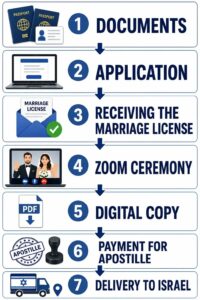
- Documents and application. Both spouses submit valid foreign passports. If either has been divorced before, the decree is submitted as-is — it does not need English translation and does not need its own apostille, a detail that trips up a surprising number of couples who assume every foreign document needs the full treatment.
- Marriage license issued. Utah issues the license remotely once the application clears. From this point, the clock starts: the license is valid for 32 days.
- Ceremony scheduled within the license window. The couple and a licensed officiant connect by Zoom. The officiant reads a short declaration of intent — as of May 2026, including the verbal remote-appearance warning noted above — the couple exchanges vows, and the marriage is solemnized, typically a 10–15 minute call, not a production.
- Certificate issued by Utah County. Once the officiant files the paperwork, the state issues the marriage certificate. A digital version is usually available first, with the certified paper original following by mail.
- Apostille attached. The certificate is apostilled through the Utah Lieutenant Governor’s office under the 1961 Hague Convention, making it a document Israel is required to accept as authentic — a step covered in full in the next section.
What the License Doesn’t Require
No separate certificate of no impediment. No proof of address. No notarized affidavit of single status. For most couples, a passport and — if applicable — an unmodified divorce decree is the entire documentary bar.
Filing It Yourself vs. Using an Agency
Some couples try this without an agency, and it can work — but three details catch people out often enough to be worth naming: the 32-day license window (miss it, and the ceremony has to be rescheduled from scratch), confirming the officiant’s Utah credentials before the call, and remembering the apostille is a separate step from the certificate, not something that happens automatically. None of these is complicated once you know to check for it; they’re just easy to miss the first time.
The Utah Law Behind It
The legal backbone here is Utah Code § 81-2-305, the section addressing who may solemnize marriages and under what conditions — including remote appearance by the couple, provided the officiant is physically present in the state. A companion provision, § 81-2-302, sets the license’s 32-day validity window and its use-within-state requirement, and — since the May 2026 amendment — the officiant’s verbal-warning obligation described above. Both sections were recodified in 2024 — moving from the old Title 30 to the current Title 81 — so any article or agency still citing “Utah Code § 30-1-9” is quoting a repealed number.
Witness requirements follow the same statute: witnesses can be present with either spouse over video, and there’s no citizenship or residency requirement attached to who can serve as one.
Israel’s Side of the Recognition
On the Israeli end, the operative legal test has three parts, applied consistently since Funk-Schlesinger: was the marriage concluded validly under the foreign jurisdiction’s own law, was it registered by an authorized government body there, and is it confirmed by an official document. A Utah marriage certificate, properly apostilled, satisfies all three — which is exactly what the 07.03.2023 ruling confirmed when it directed the Population and Immigration Authority to register these marriages rather than treat video ceremonies as some kind of gray area.
Academic commentary has tracked this shift too. A European Journal of Law and Technology analysis of cross-border recognition specifically discusses Utah’s remote-officiant model as a test case for how international private law handles marriages formed without physical travel. A separate Brooklyn Journal of International Law piece examines how Israeli conflict-of-laws doctrine treats foreign marriage recognition more broadly — useful background for understanding why this isn’t a novel legal theory, just a new application of an old one.
From Certificate to Apostille: Turning a Utah Document Into an Israeli Fact
An apostille isn’t a stamp that says “this marriage is now recognized everywhere.” That’s a common misreading, and it matters to get right. What an apostille actually certifies is narrower and more mechanical: that the document is authentic and was issued by the government body it claims to be from. Think of it as a legal bridge rather than a passport stamp — without it, a Utah marriage certificate is just paperwork from another country that an Israeli clerk has no obligation to accept at face value. With it, the same document becomes something Israel is bound by the Hague Convention to treat as genuine.
Recognition of the marriage itself — actually updating Israel’s population registry — is a separate, later step, covered next.
The Realistic Timeline
From the Zoom ceremony to holding the apostilled certificate: about 30 days on average. From there to a fully updated entry in Israel’s population registry: another few weeks, for a total of roughly six to eight weeks start to finish. Couples who’ve read “14 days” somewhere online are reading an outdated or simply incorrect figure — thirty is the number that holds up against actual Utah County processing times.
What to Check Before Paying Anyone for This Step
If a document isn’t apostilled, it’s not a recognition problem yet — it’s an authentication problem, and it needs solving before the marriage certificate goes anywhere near an Israeli government office. Confirm the apostille was issued by the Lieutenant Governor’s office specifically, not just stamped by a third party claiming authority it doesn’t have.
What Happens After the Wedding: Registering With Israel’s Ministry of Interior
Certificate and apostille in hand, the couple submits both to Israel’s Population and Immigration Authority to update the population registry — this is governed by MVI Instruction 2.11.0001, which sets out how personal-status changes from a marriage or divorce abroad are processed. Both spouses generally need to appear, the original apostilled certificate is required, and depending on the office, a certified Hebrew translation may be requested even though it wasn’t required for the Utah filing itself — worth confirming with the specific branch beforehand, since practice varies slightly by office.
For couples where one spouse is a foreign national, marriage registration and the separate process of obtaining residency status (commonly referred to as Stupro) are not the same procedure and don’t happen automatically together. Registering the marriage confirms marital status in Israel’s records; it does not by itself grant the foreign spouse a visa, residency permit, or citizenship. That’s a distinct application, with its own timeline, filed afterward — a distinction agencies sometimes blur because “marriage equals status” sounds simpler than the actual two-step reality.
Couples relocating a foreign spouse to Israel, or navigating this second step, may also want to look at the visa and status process for a foreign spouse or partner, which walks through what comes after the marriage is on the books.
Name Changes and Bituah Leumi
If either spouse is changing their surname, that’s submitted at the same registry appointment, not separately. Separately from the registry, married couples in Israel are generally expected to notify Bituah Leumi (National Insurance) of the change in marital status within 30 days, since it can affect benefit calculations, tax brackets, and eligibility categories tied to household status.
Marriage in Israel: Utah vs. Cyprus vs. Georgia vs. Prague
Couples weighing marriage in Israel options usually land on the same shortlist. Here’s how they actually compare, cost and hassle included — the rabbinate isn’t on this table because it’s a different category of process entirely, not a comparable civil alternative.
| 🟦 Utah (Zoom) | 🟥 Cyprus | 🟥 Georgia | 🟥 Prague | |
|---|---|---|---|---|
| Travel required | None | Flight + 1–3 nights | Flight + 1–3 nights | Flight + 1–3 nights |
| Typical total cost | ₪1,980 all-inclusive | ₪5,000–8,000 | Comparable once travel is added | Comparable once travel is added |
| Same-sex couples | Recognized once registered in Israel | Civil union only since 2015, not marriage | Not legally recognized | Marriage available, recognition in Israel follows the same registrar-only test |
| Apostille required | Yes, included in process | Yes | Yes | Yes |
| Time to Israeli recognition | ~6–8 weeks | Similar, plus travel logistics | Similar, plus travel logistics | Similar, plus travel logistics |
| Physical presence of both spouses | Not required | Required | Required | Required |
The travel-destination options aren’t obsolete — some couples specifically want an in-person ceremony abroad, and for them a Cyprus or Prague wedding still makes sense. But for anyone whose only goal is a legally valid marriage in Israel with the least friction, the Zoom route wins on every line of this table except “feels like a wedding trip” — which, fairly, matters to some people more than the spreadsheet does.
Who This Route Actually Fits — and Who Should Look Elsewhere
Good fit: interfaith couples, couples without confirmed Jewish status through the rabbinate, same-sex couples, couples where one partner can’t easily travel (late pregnancy, active military service, immigration-status restrictions), and anyone who simply wants a non-religious civil process.
Not the right tool for: couples who are eligible for and want a religious ceremony through their own recognized religious court — that process is often simpler and doesn’t need this at all. It’s also not a shortcut to citizenship or a work visa; those remain separate applications regardless of how the marriage was performed.
Voices We Hear a Lot
“Is this actually different from just living together unmarried?” Legally, yes — a registered marriage changes inheritance defaults, next-of-kin medical decision authority, tax filing status, and the starting point for a foreign spouse’s residency process. Cohabitation agreements can replicate some of this, but not all of it, and not automatically.
“What if my ex-spouse’s divorce was finalized less than two months ago?” This is exactly the kind of edge case worth a direct conversation before booking, since document requirements can shift slightly by circumstance — worth confirming rather than assuming either way.
More Situations This Covers
The couples above aren’t the only ones this route serves. A few categories that come up constantly and deserve their own mention:
Tourists in Israel. You don’t need Israeli citizenship or residency to use this process — a couple visiting on tourist visas can complete the entire Zoom ceremony during their stay. Chloe and Ronen, in Tel Aviv on a three-week visit, scheduled theirs specifically to fit inside that window rather than extend their trip.
New repatriates (olim khadashim). Recently arrived olim sometimes face a gap: their Jewish status through the rabbinate isn’t yet confirmed, but they’re already building a life in Israel. Ana and Boris, both recent repatriates in Be’er Sheva, used the Utah route while their halachic status was still being reviewed, rather than wait indefinitely.
Students. International students on study visas face the same core question as tourists — no long-term status required to marry this way. Jing and Amit, in Haifa while Jing finished a graduate program, didn’t want their relationship status tied to how long her student visa happened to run.
Widows and widowers. Remarrying later in life usually means only the date of a prior spouse’s death needs confirming, not the more complex documentation that follows a divorce. Marek, a widower in Bat Yam, found this the simplest part of marrying Devora — no divorce decree to track down, just a death certificate already on file.
People with temporary or pending status. Foreign workers and caregivers with an unresolved status question sometimes worry that marrying will complicate rather than help their paperwork. It’s a fair thing to ask about directly before booking, and worth confirming case-by-case rather than assuming either outcome.
Common Myths About Marriage in Israel Through Utah
“You have to fly to Utah in person.” Not true — that was never a requirement even before 2023; the whole point of § 81-2-305 is that only the officiant needs to be physically in Utah.
“Both spouses need to be in the same room, or even the same country.” Not true. Couples have completed this ceremony from two different continents on the same call.
“An apostille means the marriage is automatically recognized everywhere.” Only partially true. An apostille confirms the document is authentic — it doesn’t by itself register the marriage anywhere. Israel’s registration still requires a separate submission to the Population and Immigration Authority.
“Marrying this way gets a foreign spouse automatic citizenship or a visa.” Not true. Registering the marriage and applying for residency status are two separate procedures with separate timelines.
“If you’re not Jewish, you can’t marry in Israel at all.” Not true. Christian, Muslim, and Druze couples can marry through their own recognized religious courts — the Utah route exists for people that structure doesn’t cover.
“The marriage license lasts as long as you need it to.” Not true — it expires 32 days after issuance, and missing that window means starting the license process over.
After Divorce, Relocation, or Losing a Spouse
Divorce. A marriage registered this way dissolves the same way any civil marriage does — through Israel’s Family Court, not the rabbinate, since it was never a religious marriage to begin with. That distinction matters: there’s no get (religious divorce document) required, because none was involved in creating the marriage. If one spouse is a foreign national whose status in Israel depended on the marriage, a divorce can affect that status procedure — this is worth raising with the relevant authority early rather than after the fact, since the impact varies by how far along the status process already is.
Relocating to a third country later. Couples sometimes ask what happens if they move somewhere other than Israel or Utah down the line. Most countries apply a similar underlying test to Israel’s own: was the marriage valid where it was performed, and is it backed by a proper, authenticated document.
An apostilled Utah certificate is generally accepted as authentic across the roughly 120 countries that are parties to the Hague Apostille Convention — though authenticity and recognition remain separate questions, and a handful of jurisdictions apply their own restrictions to certain marriages (same-sex marriages in particular) regardless of how the document was authenticated. Checking the specific destination country’s own recognition rules before relying on this for an international move is worth doing rather than assuming automatic acceptance.
Losing a spouse. For inheritance purposes, a marriage registered this way carries the same legal weight as any other registered civil marriage in Israel — it isn’t treated as a lesser or provisional status. Couples with concerns here, particularly where one spouse has children from a previous relationship, often choose to formalize a will alongside the marriage rather than rely on default inheritance rules alone.
How to Check Any Marriage Agency Before You Pay a Shekel
This isn’t a pitch to only check us — it’s a genuine seven-point list, useful against any agency offering this service, ours included.
- Read the Supreme Court ruling yourself. It’s public. If an agency can’t point you to it, or gets vague when asked, that’s a signal.
- Check Google reviews — and read the negative ones critically. Out of 66 reviews left for this agency, five came from accounts that never actually used its services, a pattern consistent with competitor-planted negative reviews rather than real client complaints. Read reviews for detail and specificity, not just star count.
- Ask for the officiant’s Utah credentials before paying anything. A legitimate agency won’t hesitate.
- Confirm the payment structure. Split payment (deposit, then balance after the ceremony) is a healthier structure than “pay it all now.”
- Ask what happens if you need to reschedule. A straight answer here, with specifics, tells you more than any testimonial.
- Check for press mentions or independent coverage, not just the agency’s own site.
- Talk to a real person before paying — not just a chatbot or a form. If nobody will get on a call before you’ve paid, that’s the loudest signal on this list.
Nobody should take an agency’s word over their own research — check the law, check the reviews, check the officiant, and only then decide.
Real Couples, Real Doubts
Emma and Itamar, Ra’anana. Emma’s Irish and not Jewish; Itamar’s family expected a rabbinate wedding. Neither the rabbinate nor a civil option in Israel fit their situation. They spent close to two weeks reading the Supreme Court ruling and comparing agencies before booking — by their own account, more time researching than the ceremony itself took.
Master Sergeant Omer, stationed near Eilat. A reservist with limited connectivity windows, Omer scheduled the Zoom ceremony during a scheduled break between shifts. The whole call ran under fifteen minutes; the harder part, he said, was getting cell signal steady enough for the video not to freeze.
Noa and Liat, Kiryat Tivon. A same-sex couple who’d initially looked at Georgia, until they found out Georgian law doesn’t recognize same-sex marriage at all — a detail their first agency hadn’t mentioned. Utah, with a registered marriage that Israel then recognizes under the Ben-Ari precedent, was the option that actually worked for them.
Valentina and Boaz, Rishon LeZion. Eight months pregnant, Valentina didn’t want to fly anywhere. The Zoom option meant she didn’t have to choose between traveling and getting married before the baby arrived.
Katarzyna and Eli, Nahariya. Katarzyna, a foreign caregiver with a pending status question, worried that marrying through an unfamiliar process might complicate her paperwork rather than help it. It didn’t — but she and Eli specifically asked, before paying, how marriage registration and her separate status procedure would interact, and got a clear answer before booking.
Marek and Devora, Bat Yam. Marek, a widower, expected the paperwork to be complicated the second time around. It wasn’t — no divorce decree to chase down, just a death certificate he already had on file from years earlier.
Chloe and Ronen, Tel Aviv. Chloe was visiting on a tourist visa. They scheduled the ceremony deliberately within her three-week trip rather than push back her flight home.
Ana and Boris, Be’er Sheva. Both recent repatriates, still waiting on confirmation of halachic status through the rabbinate. Rather than put their lives on hold, they married through Utah while that review continued.
Jing and Amit, Haifa. Jing was finishing a graduate program on a student visa. Neither wanted their relationship status tied to how long that visa happened to run.
Money Matters: Taxes, Bituah Leumi, and Your New Surname
Marriage can affect Israeli tax credit points (nekudot zikuy), joint or separate filing status, and Bituah Leumi benefit calculations — but not automatically or uniformly. Whether a couple benefits from joint filing versus filing separately depends on the income gap between spouses and each partner’s employment status; there’s no single answer that applies to every household, which is exactly why this is worth a conversation with an accountant rather than an assumption.
Bituah Leumi eligibility categories — for benefits tied to household size, spousal coverage, or survivor benefits — shift the moment marital status changes in the registry, which is the practical reason the 30-day notification window exists: benefit calculations run off whatever status is on file, not what’s actually true if nobody’s updated it.
What’s consistent across cases: the 30-day Bituah Leumi notification window after the marriage is registered, and the fact that a surname change, if either spouse wants one, is filed at the same population registry appointment as the marriage itself — not as a separate errand weeks later.
Frequently Asked Questions
Is a marriage in Israel performed via Zoom in Utah actually legal? Yes. The Israeli Supreme Court’s March 2023 ruling in Ministry of Interior v. Bril (עע”ם 7368/22) confirmed that the Population and Immigration Authority must register these marriages the same way it registers any other marriage validly performed abroad. It’s not a gray area or an unofficial workaround — it’s a tested legal precedent.
Do both spouses need to be in the same country during the ceremony? No. Utah Code § 81-2-305 requires the officiant to be physically present in Utah — it doesn’t require the couple to be together in one location, let alone in Utah itself. Couples on different continents have completed this ceremony together over the same video call.
How much does the whole process cost? ₪1,980, all-inclusive: agency coordination, Utah state fees, and the apostille. There’s no separate line item that gets added later.
What documents does a foreign spouse need to provide? A valid passport, and — if applicable — a prior divorce decree. The decree doesn’t need translation into English and doesn’t need its own separate apostille.
How long is the Utah marriage license valid? 32 days from issuance. The ceremony has to be completed within that window, or the license needs to be reissued.
How long until we have the actual marriage certificate? About 30 days on average from the ceremony date. A digital version is often available sooner, with the certified paper original following by mail.
Does an apostille mean Israel automatically recognizes the marriage? Not by itself. The apostille confirms the certificate is authentic — a separate step, registering it with Israel’s Population and Immigration Authority, is what actually updates your legal status in Israel.
Can same-sex couples use this route? Yes. Since Ben-Ari v. Director of Population Registry (2006) established that same-sex marriages performed abroad get registered on the same basis as any other foreign marriage, a Utah marriage falls under that same principle.
What if I’m not Jewish — can I still marry in Israel through the rabbinate? If you belong to a recognized religious community — Christian, Muslim, or Druze, for example — yes, through your own religious court. This Utah route is specifically for people who fall outside any recognized religious jurisdiction, or who don’t want a religious ceremony at all.
Will marrying through Utah get my foreign spouse a visa or citizenship? Not automatically. Marriage registration and immigration status are separate processes with separate applications and timelines. Registering the marriage is often a prerequisite step, not the whole procedure.
What happens if we need to reschedule the ceremony? It happens, and it’s handled by working within the 32-day license window — worst case, a new license is filed. A legitimate agency should walk you through this before you pay, not just when it comes up.
Is the price of ₪1,980 ever going to increase? No. The pricing model depends specifically on staying cheaper than travel-based alternatives; raising it would undercut the entire reason couples choose this route.
Can pregnant women or people who can’t easily fly use this option? Yes — it’s one of the more common reasons couples choose it specifically, since neither spouse needs to travel anywhere for the ceremony.
Do we need witnesses, and where do they need to be? Witnesses can join over video from wherever they are; there’s no residency or citizenship requirement attached to who can serve as one.
Can tourists or international students in Israel use this process? Yes — no Israeli citizenship or residency is required. Tourists and students on valid visas have completed this exact process during their stay in Israel.
What happens to this marriage if we later divorce? It dissolves through Israel’s Family Court, not the rabbinate, since it was never a religious marriage. There’s no religious divorce document required. If one spouse’s status in Israel depended on the marriage, that’s worth raising with the relevant authority as part of the divorce, since the effect on status varies by case.
Is this different from just living together without getting married? Legally, yes — a registered marriage affects inheritance defaults, medical decision-making authority, tax status, and the starting point for a foreign spouse’s residency process, none of which cohabitation alone establishes automatically.
How do we know the certificate and apostille aren’t fake? Both are issued by government bodies — the Utah County Clerk and the Lieutenant Governor’s office respectively — and can be verified through Utah’s own digital registry. Neither can be reproduced outside an actual government filing.
Conclusion
Marriage in Israel outside the rabbinate used to mean a flight, a hotel, and a few thousand shekels nobody particularly wanted to spend. It doesn’t anymore. The legal groundwork — from Funk-Schlesinger through Ben-Ari to the 2023 ruling — was decades in the making, but the practical result for couples today is simple: a video call, a state-issued certificate, an apostille, and a registry update, in that order, over roughly six to eight weeks. It covers more ground than most people expect too — tourists, students, widowers, recent repatriates, and couples who’ll never set foot in the same country as each other before the ceremony.
The part worth doing carefully isn’t the ceremony itself — it’s checking, before any money moves, that the agency, the officiant, and the paperwork are exactly what they claim to be.
This material is informational and does not replace individualized legal consultation for your specific circumstances.
⭐⭐⭐⭐⭐ A.R.IMMIGREALTY — Israel ☎ tel:+972542150724 · WhatsApp 24/7: wa.me/972542150724 · ec-passport.co.il · Email: abinder1909@gmail.com
About the author: Alexander Binder, founder and director of A.R.IMMIGREALTY, has 27 years of legal experience abroad. The agency has operated since 2019 and has coordinated online Utah marriages since the March 2023 Supreme Court ruling, registering 300+ marriages through this process. Offices in Bnei Brak (Masada 9) and Ramat Gan (Herut 34), open 24/7 including Shabbat until 19:00.
Related reading: 🟩 Weddings Abroad — Full Country Guide 🟩 Wedding in Georgia 🟩 Contact A.R.IMMIGREALTY
1️⃣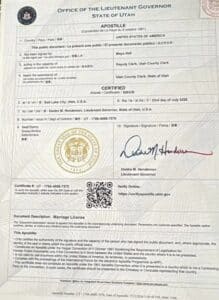
1️⃣
The material has been updated for 2026.
Can Couples Living in Different Countries Get Married Online?
Long-distance relationships are becoming increasingly common. One partner may live in Israel while the other lives in France, the United States, Canada, or another country. Fortunately, modern technology and Utah’s online marriage process make it possible for couples to legally marry without traveling or being in the same location. This solution saves time, reduces travel costs, and allows international couples to begin their married life sooner.