MARRIAGE IN ISRAEL ₪ 1️⃣9️⃣8️⃣0️⃣ (Online Marriage in Utah) in 2026 ⭐⭐⭐⭐⭐ Call me +972-54-215-07-24, WhatsApp 24/7
Marriage in Israel through online registration in Utah County is fully recognized by the Israeli Ministry of Interior (Misrad HaPnim) based on three foundational legal sources: Utah Code §30-1-9, the American statute explicitly permitting Civil Marriage ceremonies via video conferencing without physical presence in the United States; the Israeli Supreme Court ruling of March 7, 2023 (HCJ 22-073-680), which obligated the Israeli MVD to register such marriages in the population registry; and Ministry of Interior Instruction 2.11.0005,
How Marriage in Israel Through Utah Actually Works: License, Certificate, Apostille and the Law Behind It
Title: How Marriage in Israel Through Utah Actually Works: License, Certificate, Apostille and the Law Behind It (2026) Meta Description: The legal mechanics of marriage in Israel through Utah: Marriage License vs Certificate, apostille, Population Registry, conflict of laws and the 2023 Supreme Court ruling — explained step by step. URL: /marriage-in-israel-utah-legal-guide/
A MARRIAGE IN ISRAEL can begin in a rather unexpected place: not under a wedding canopy in Jerusalem, not at a municipality in Cyprus, and not after a flight to Georgia — but in front of a laptop at home.
For many couples, that sounds suspiciously simple.
And the price of ₪1,980 often makes people even more suspicious.
We hear roughly the same question again and again:
“Where is the catch?”
This guide does not repeat the pricing table and step-by-step checklist already covered in our complete Online Marriage in Utah guide — it goes one level deeper, into the legal mechanics: why the certificate is valid, what an apostille actually proves, what the 2023 Supreme Court ruling did and did not decide, and where the whole model comes from in conflict-of-laws terms.
It is a reasonable question. A couple planning a MARRIAGE IN ISRAEL may already have heard stories about flights abroad, hotels, translators, foreign registrars, apostilles, couriers and expenses that seem to reproduce overnight.
The Utah model works differently.
In 2026, Utah County continues to operate a digital marriage-license system. The official Utah County Clerk website states that applicants can complete the entire application online, verify their identities digitally and receive a digital marriage license. Utah has no citizenship or residency requirement for obtaining that license.
The couple does not have to fly to the United States.
For a remote ceremony, the crucial geographical element is the officiant: the person solemnizing the marriage must be physically located in the State of Utah. Utah County expressly explains that the officiant’s location establishes the jurisdiction for a remote marriage ceremony.
That single legal detail changes the economics of MARRIAGE IN ISRAEL.
Instead of transporting two people to the jurisdiction where the marriage takes place, the law allows the parties to appear remotely while the authorized officiant remains in Utah.
The airplane disappears from the equation. So does the hotel. And quite a few other expenses follow them out of the door.
That is why a MARRIAGE IN ISRAEL through Utah can cost ₪1,980 through A.R.IMMIGREALTY without requiring the couple to travel abroad. The low price is not created by removing the legal marriage from the package. It is created largely by removing the trip.
Quick answer: can you legally get married online while living in Israel?
Yes. Utah County permits eligible couples, including non-U.S. citizens and non-residents, to apply for a marriage license online and participate in a remote marriage ceremony without travelling to Utah, provided the statutory requirements for the ceremony are satisfied.
Utah County’s own FAQ is unusually direct on this point: there is no Utah residency or U.S. citizenship requirement for the marriage license. Its digital system makes it possible for couples to apply, participate in a remote ceremony and obtain an official Utah County marriage license/certificate without visiting the office.
There is an important distinction, however. The fact that a remote marriage is validly solemnized under Utah law does not, by itself, determine every legal consequence of that marriage in another country. Utah County itself warns couples that a marriage solemnized under Utah law through online remote appearance may be invalid in the country where the parties reside.
For a couple considering MARRIAGE IN ISRAEL, therefore, two questions must never be confused:
Question 1: Was the marriage legally performed under Utah law? Question 2: What legal and administrative consequences does that foreign marriage have in Israel?
They sound similar. Legally, they are not the same question.
This distinction is particularly important because Israel has its own rules concerning the Population Registry, foreign public documents, apostilles, immigration status and the registration of a foreign spouse. We will examine those separately.
Why MARRIAGE IN ISRAEL is a complicated search query
Someone typing MARRIAGE IN ISRAEL into Google may actually be asking five different questions at once: Can we marry? Where can we marry? Does Israel recognize the document? Do we have to leave Israel? And how much will the entire procedure actually cost?
That is because Israel does not have a universal domestic civil-marriage system equivalent to the ordinary civil registry model found in many European countries.
For some couples, this creates no practical difficulty. For others, it becomes the central problem. The issue may arise for an interfaith couple, a person whose religious status creates difficulties for a religious ceremony, an Israeli marrying a foreign citizen, a same-sex couple, people living in different countries, or simply a couple who does not want a religious wedding.
The result is peculiar. Two people may be perfectly willing to marry each other, yet spend more time researching where they can legally do it than deciding whether they actually want to.
Romance has survived many things. Bureaucracy remains an ambitious opponent.
The traditional solution: marry abroad
For decades, one of the practical answers to MARRIAGE IN ISRAEL was not actually to marry in Israel. Couples travelled abroad.
Cyprus became particularly familiar to Israelis, and A.R.IMMIGREALTY still arranges wedding trips to Cyprus for couples who want a physical ceremony abroad. Other couples considered Georgia or European jurisdictions depending on their citizenship, documents and personal circumstances.
This model can work. But a wedding abroad contains a cost that is sometimes hidden by the deceptively simple phrase “civil marriage abroad.” The ceremony is only one line of the budget. There may also be: air tickets, accommodation, airport transfers, local transportation, document preparation, translations, administrative fees, apostille expenses, courier costs and working days lost by one or both partners.
If one partner cannot travel easily, the problem becomes larger than money. A foreign spouse may face visa restrictions. A soldier may have limited leave. A pregnant woman may not want to fly. The partners may even live in different countries.
For such couples, the real comparison is not simply Utah ceremony vs Cyprus ceremony. It is: remote legal procedure vs an international trip organised for the purpose of signing a marriage document. Those are economically and logistically different products.
What changed with Utah online marriage?
Utah did not invent marriage at a distance. Questions about marriages performed without the physical presence of both spouses are much older than Zoom.
The legal literature on proxy marriage and conflict of laws goes back more than a century. Ernest G. Lorenzen examined Marriage by Proxy and the Conflict of Laws in the Harvard Law Review in the early twentieth century. Later scholarship continued examining how the traditional conflict-of-laws principle known as lex loci celebrationis — broadly, the law of the place where the marriage is celebrated — operates when the parties are not physically present together, and a European Journal of Law and Technology analysis has since applied the same question directly to Utah officiant-based remote ceremonies.
Digital technology gave that old question a new body. The webcam replaced the proxy. The underlying legal problem remained fascinatingly familiar: where does a marriage legally take place when the people participating in it are physically somewhere else?
Utah’s answer is unusually practical. For a remote appearance ceremony using a Utah marriage license, Utah Code §81-2-305 requires the officiant to be physically present in Utah. The officiant’s physical location is recorded as the ceremony location and establishes the necessary jurisdiction.
The spouses may participate remotely. So may the witnesses.
This is the mechanism that makes a Utah-based MARRIAGE IN ISRAEL possible without transporting the couple to the United States.
How a Utah online marriage actually works
Strip away the advertising language and the procedure is surprisingly mechanical. There are several legally distinct stages: the Utah County Clerk currently states that a normal online marriage-license application generally takes around 15–20 minutes if automatic identity verification succeeds. If manual verification is necessary, the process may instead require several business days.
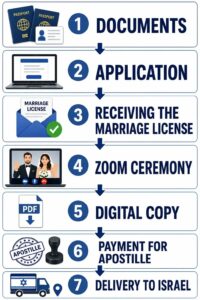
This is one reason MARRIAGE IN ISRAEL through Utah should not be described merely as “a Zoom wedding.” Zoom is only the communication channel. The legal machinery behind the screen is more important: application, identity verification, marriage license, authorized officiant, witnesses, solemnization, electronic submission and marriage certificate.
Calling the whole procedure “a Zoom wedding” is a little like calling online banking “a password.” True, but spectacularly incomplete.
Marriage License and Marriage Certificate are not the same document
This distinction causes an astonishing amount of confusion.
A Marriage License is the authorization allowing the marriage to be solemnized. A Marriage Certificate records that the marriage has actually been solemnized. Before the ceremony, the couple has a license. After the ceremony has been properly completed and returned through the Utah County digital system, the resulting record serves as evidence of the marriage.
Utah County explains that its system is digital: the officiant completes the required submission electronically, enters information concerning the ceremony and the two witnesses, digitally signs the submission and sends the certificate of marriage electronically.
For a couple researching MARRIAGE IN ISRAEL, confusing these two stages can produce unnecessary panic.
“We already have the license. Are we married?” Not yet merely because a license was issued. The ceremony still matters.
How long is the Marriage License valid?
There is no waiting period after issuance of a Utah marriage license, according to Utah County. The marriage may therefore be solemnized on the same day the license is obtained, assuming the other requirements are satisfied.
But the license does not remain valid indefinitely. It must be used within 32 days of issuance. Utah County recommends applying approximately 10–15 days before the planned ceremony.
That 32-day period is an important practical detail when organising a MARRIAGE IN ISRAEL remotely. Applying too early achieves nothing. Applying too late may create avoidable stress if identity verification requires manual review. The sensible approach is to leave a buffer.
Do both partners have to be in the same room?
No. This is one of the most useful characteristics of the Utah system.
Utah County expressly allows the applicants to work on the same marriage application from different devices and locations. Each person completes his or her own section, performs identity verification and signs the required affidavit.
During a remote ceremony, the couple also does not have to be physically together. The officiant, both partners and the witnesses must instead be able to see and hear one another in real time.
Consider a realistic example. Daniel lives in Tel Aviv. Anna is temporarily in Warsaw. A witness is in Haifa. Another witness is in London. The officiant is physically sitting in Utah. Geographically, that looks less like a wedding party and more like an airline route map.
Legally, however, physical separation of the participants does not automatically prevent the Utah remote ceremony, provided the statutory and administrative requirements are met.
For international couples, this changes the practical meaning of MARRIAGE IN ISRAEL. The question is no longer necessarily, “How do we get both partners to the same foreign registry office?” It may become, “Can everybody join the same video conference?” That is a much cheaper problem to solve.
The witnesses: another frequently misunderstood requirement
A Utah remote marriage ceremony requires two witnesses. They must each be at least 18 years old. They do not have to be physically present with the couple or with each other.
For ceremonies conducted through the Utah County Clerk, witnesses need identification because the officiant verifies their identities before the ceremony. Utah County lists a driver’s licence or passport as examples.
There is another useful detail. The witnesses’ names are entered into the electronic officiant submission, but Utah County states that the witnesses are not required to sign the certificate.
This sounds minor until somebody begins organising a remote wedding involving four people in three countries and asks where the witnesses are supposed to sign. Answer: Utah’s digital system was designed precisely so that the paperwork does not have to travel from hand to hand.
What happens during the Zoom ceremony?
A legal remote ceremony is not simply a video call during which somebody says, “Congratulations.” Utah requires a genuine solemnization. Each party must willingly make a declaration of intent to enter the marriage. The officiant then pronounces the marriage.
For a remote ceremony, the participants must be able to see and hear one another. The witnesses observe the declarations and pronouncement.
Couples may also have an opportunity to exchange personal vows and rings. Utah County’s own remote ceremonies use a simple script and expressly provide an opportunity for personal vows and an optional ring exchange.
The rings are therefore romantic. They are not the jurisdiction. The officiant’s physical location in Utah is. That distinction is considerably less poetic but much more useful when dealing with government offices later.
What happens immediately after the ceremony?
This is one of the strongest advantages of Utah County’s digital infrastructure.
For ceremonies scheduled directly through the Clerk’s Office, Utah County states that immediately after the ceremony — before the video meeting ends — the officiant finalizes the marriage license. The digital marriage certificate is then made available within minutes.
That does not mean a PDF printed at home will necessarily satisfy every authority in every country. Utah County specifically warns that although its digital certificate can be electronically verified, a home-printed version is not a certified copy. Each jurisdiction decides what form of document it will accept.
This distinction becomes particularly important when a MARRIAGE IN ISRAEL proceeds to the Israeli registration stage. Digital convenience in Utah and documentary requirements in Israel are two different layers of the process.
Why does the A.R.IMMIGREALTY package cost ₪1,980?
This question deserves a direct answer because an unusually low price can reduce trust instead of increasing it.
People know roughly what an international wedding trip costs. Then they see ₪1,980. The instinctive reaction is: something must be missing.
The more useful question is not whether the price is low. It is which expenses disappeared.
The Utah procedure removes the need to transport the couple to the jurisdiction in which the officiant is physically located. That eliminates the largest variable expenses associated with the traditional “fly abroad and marry” model.
A.R.IMMIGREALTY’s ₪1,980 offer is structured as a service package for organising the Utah online-marriage process rather than as an international wedding trip. That distinction matters.
What you should check before paying any company
Do not trust an agency merely because its website looks expensive. And do not distrust one merely because its price is low.
Utah County itself acknowledges that wedding-planning companies and officiants work with couples using the county’s marriage-license system. But the County expressly says that it does not endorse or partner with those private companies and encourages consumers to compare their services, prices and reviews.
That is excellent advice. Including for our own clients.
Before paying for a MARRIAGE IN ISRAEL service, check: the company’s legal/business identity; how long it has operated; independent reviews; exactly what is included in the price; whether the Marriage License is genuinely issued through Utah County; who arranges the officiant and witnesses; who handles the apostille; whether international document delivery is included; what happens if the ceremony date changes; whether additional fees can appear later.
A low price should survive questions. If it collapses after the third question, it was never really the price.
We do not ask clients to believe us
This is particularly important in an industry involving foreign documents.
The central stages of a Utah marriage are independently verifiable. The Utah County Clerk is a real government authority. The marriage-license system is public. The rules for remote ceremonies are published by the County. The statutory requirements governing solemnization exist in Utah law. The resulting marriage record is issued through the official county system.
In other words, a client does not have to rely on a salesman’s ability to sound convincing. Government records are rather indifferent to charisma. That is exactly how it should be.
Is a Utah online marriage “just an internet certificate”?
No. The digital nature of the process does not turn the marriage record into a private certificate produced by a website.
Utah County describes its marriage-license system as completely digital. A marriage license is issued by the County, the ceremony is solemnized by an authorized officiant, and the officiant completes the official electronic submission. Certified copies can subsequently be ordered from Utah County, and the County also provides a process for requesting an apostille for international use.
That chain of authority matters enormously. There is a world of difference between “We created a marriage certificate online” and “A competent governmental authority created and maintains the official marriage record after a marriage solemnized according to its law.” The second proposition is what matters for MARRIAGE IN ISRAEL.
One warning before going further
An online marriage should not be sold as magic. A marriage certificate does not automatically solve immigration problems. An apostille does not automatically mean that every country recognizes every legal consequence of the marriage. Registration of marital status does not automatically grant an Israeli visa, permanent residence or citizenship to a foreign spouse. These are different legal questions.
Utah County itself refuses to promise international recognition and tells couples to check the rules of the jurisdiction in which the document will be used.
For Israel, that makes the next stages of our analysis crucial. We need to examine what Israeli authorities do with the Utah certificate, what the Israeli courts have actually decided, why the Supreme Court’s 2023 decision became so important, what an apostille proves — and, equally importantly, what it does not prove.
That is where MARRIAGE IN ISRAEL stops being merely a story about Zoom and becomes a question of Israeli administrative law, foreign public documents and the Population Registry.
This material is for informational purposes and does not replace individual professional advice.
MARRIAGE IN ISRAEL: Registration, Apostille, Israeli Courts and a Foreign Spouse
For a couple sitting in Tel Aviv, Haifa or Jerusalem, the Utah ceremony may take only minutes. The paperwork has a longer life.
Once the Zoom window closes, the central question changes. The couple is no longer asking whether Utah permits the marriage. They are asking what they can do with the resulting American marriage certificate in Israel.
This is the point where discussions about MARRIAGE IN ISRAEL frequently become confused. Four different legal concepts are thrown into one basket: validity of the marriage under Utah law → authentication of the American document → registration of marital status in Israel → immigration status of a foreign spouse.
They are connected. They are not identical. Understanding that distinction prevents some of the most expensive mistakes couples make after a foreign marriage.
What does an apostille actually do?
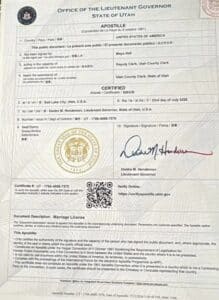
An apostille authenticates a public document for use abroad under the Hague Apostille Convention system. In practical terms, Israel needs a reliable method of determining that a foreign marriage certificate presented to an Israeli authority is genuinely an official document issued through the relevant foreign authority. The apostille performs that authentication function.
For a Utah marriage certificate intended for official use in Israel, this becomes part of the documentary chain. But here is the sentence worth remembering: an apostille authenticates a document. It does not independently decide every legal consequence of the marriage recorded in that document.
This difference is frequently lost in commercial descriptions of MARRIAGE IN ISRAEL. An apostille is not a magical international stamp saying “every country must now treat these people as married for every conceivable purpose.” Its function is narrower. It establishes the authenticity of the relevant public document through the simplified international authentication mechanism. Whether the marriage is registered, recognized or produces a particular legal consequence is determined by the law and administrative rules of the country where the certificate is presented.
Apostille and recognition are different questions
Think of a university diploma. An apostille can authenticate that the diploma was genuinely issued. It does not force every university in the world to admit its holder to a doctoral programme.
The same conceptual distinction matters for MARRIAGE IN ISRAEL. The apostille deals with the document. Israeli law and administrative practice deal with the legal consequences for the people named in it.
That distinction becomes particularly important in the Utah context because the marriage ceremony may have occurred through remote appearance while neither spouse was physically in the United States.
What happens after the Utah Marriage Certificate is issued?
A couple planning to use the marriage certificate in Israel generally moves through a documentary sequence. This is why an advertisement saying “get married on Zoom in ten minutes” is technically describing only a small part of the process.
A MARRIAGE IN ISRAEL involving a Utah ceremony is better understood as a chain. The ceremony is the most photogenic link. The documents are the links that government offices care about.
Registration of a foreign marriage in Israel
Israel’s Population and Immigration Authority provides an official service for reporting a change in personal status. For a change resulting from marriage, the Authority currently requires, among other things, identification documents and an original marriage certificate. Foreign documents may require proper authentication and, depending on the language and circumstances, translation.
The government’s current instructions also distinguish situations involving a spouse who is not already registered in the Israeli Population Registry. That distinction matters enormously in MARRIAGE IN ISRAEL cases involving an Israeli and a foreign citizen.
What documents can become important?
The exact file depends on the couple, but the core documentary picture can include: Israeli identity documents; passports; the original foreign Marriage Certificate; proper authentication of the foreign certificate; an apostille where applicable; translation where required; evidence concerning the foreign spouse’s previous personal status; documents concerning a previous marriage, divorce or widowhood where relevant.
The Israeli government’s instructions expressly state that when a person who is not registered as a resident in the Population Registry needs to prove a previous personal status using a foreign document, that document must be original, authenticated and translated into Hebrew by a notarial translation where required.
This is not a theoretical detail. Suppose an Israeli citizen marries a Ukrainian, British or Russian citizen through Utah. The Utah marriage certificate proves one event: the marriage. It does not necessarily prove what the foreign spouse’s civil status was before that event. Israeli authorities can therefore require separate evidence concerning the foreign spouse’s previous personal status.
One document cannot be expected to tell the life story of two people. Bureaucracy, unlike relatives at a wedding, prefers separate certificates.
Does a foreign spouse need a certificate of previous marital status?
This issue deserves special attention because couples often discover it only after the wedding.
Israeli government instructions state that where a marriage involves an Israeli and a foreign citizen, evidence of the foreign spouse’s previous marital status may be required. The Ministry of Foreign Affairs gives an especially practical formulation: if the marriage certificate does not indicate the foreign citizen’s previous personal status, an authenticated certificate proving that earlier status must be attached. In countries participating in the apostille system, the appropriate apostille may be required.
This can mean evidence that the person was single, divorced, or widowed, depending on the circumstances.
For MARRIAGE IN ISRAEL, therefore, there are really two documentary timelines: before the marriage — who were you legally? After the marriage — what happened to your status? A Utah Marriage Certificate primarily answers the second question. Israel may still ask for evidence concerning the first.
Does the certificate need translation?
Not every foreign document creates the same translation problem. The Israeli Population Authority’s official service instructions provide for translation requirements in relevant circumstances, particularly for foreign documents that are not in the accepted language/form required by the authority.
A Utah Marriage Certificate is issued in English. That matters because English-language documentation is treated differently in some Israeli administrative contexts from documents issued, for example, solely in Russian, Ukrainian, Georgian or another language.
The practical rule is therefore not: “Every marriage certificate always needs a notarized Hebrew translation.” That statement is too broad. The safer rule is: check the current requirement for the particular document, language, authority and procedure in which it will be submitted. For YMYL subjects such as MARRIAGE IN ISRAEL, “usually” is not a substitute for checking.
The Utah marriage cases in Israel: why 2022–2023 changed the landscape
The legal significance of Utah online marriage in Israel cannot be explained properly without the litigation that followed the rise of remote ceremonies.
When Israeli couples began using Utah’s digital system, a fundamental administrative question appeared: can the Population Authority refuse to register the marriage merely because the spouses participated remotely from Israel rather than physically travelling to the foreign jurisdiction?
The dispute eventually reached Israel’s highest judicial level. This is the event that transformed Utah online marriage from an unusual technological workaround into a major subject in the Israeli debate about civil marriage.
What was the state concerned about?
The difficulty was not simply whether Utah had produced a piece of paper. The deeper question concerned the character and location of the marriage.
Traditional foreign civil marriage is easy to visualize. An Israeli couple flies to Cyprus. They enter a foreign civil registry. They marry there. They return to Israel with a foreign certificate. The territorial picture is obvious.
Utah remote marriage disturbed that familiar geometry. The couple could be physically sitting in Israel. The officiant was in Utah. The ceremony was conducted through real-time video. The marriage was documented through Utah’s governmental system. So where, legally, did the relevant marriage event occur?
That question is not merely philosophical. It goes directly to conflict-of-laws concepts such as lex loci celebrationis — the law of the place of celebration. It is also one reason Utah online marriage has attracted academic attention beyond Israel.
The Supreme Court proceedings of March 2023
On 7 March 2023, the Israeli Supreme Court rejected the state’s appeals (עע”ם 7368/22, Ministry of Interior v. Bril) concerning the registration of Utah online marriages in the Population Registry.
The practical result was highly significant for couples pursuing MARRIAGE IN ISRAEL through Utah: the Population Authority could not simply refuse the relevant registration because the marriage ceremony had been conducted remotely while the spouses were physically in Israel.
But this needs to be stated with legal precision. The decision concerned the state’s obligation in the context of Population Registry registration. It should not be inflated into the much broader statement: “The Supreme Court ruled that every Utah online marriage automatically has every possible legal consequence in Israel.” That is not the same proposition. The distinction is fundamental.
The 2023 ruling did not appear from nowhere
It is tempting to treat the 7 March 2023 decision as a sudden legal breakthrough invented for the Zoom era. It was not. It is the latest application of a principle Israeli courts have been refining for six decades.
In Funk-Schlesinger v. Minister of Interior (1963), the Supreme Court held that a population registrar has no authority to adjudicate the substantive validity of a foreign marriage. The registrar’s job is narrower: to record what a formal foreign public document states, not to conduct an independent legal review of whether the marriage should have been permitted in the first place. That single administrative-law principle — registration is not adjudication — has carried an enormous amount of weight ever since.
In Ben-Ari v. Director of Population Registry (2006), the same principle was extended to same-sex couples married abroad: a marriage validly performed under foreign law, evidenced by a proper foreign public document, is registered on that same registrar-only basis, regardless of whether Israeli domestic law would have permitted the same marriage to be performed inside the country.
The 07 March 2023 ruling on Utah online marriages is not a break from that line. It is the same principle meeting a new factual pattern: a foreign public document, properly issued, presented for registration — except that this time the ceremony happened over video instead of in a foreign registry office. Funk-Schlesinger established the rule. Ben-Ari confirmed the rule survives a change in who is marrying. The 2023 ruling confirmed the rule survives a change in how the marriage is conducted. Three decisions, sixty years apart, applying one continuous idea to circumstances the original court could not have imagined.
Registration is not an unlimited declaration about every area of law
Israeli jurisprudence concerning the Population Registry has historically distinguished the registrar’s administrative function from judicial determination of every substantive question concerning personal status. This matters greatly for MARRIAGE IN ISRAEL.
When a foreign public certificate satisfies the relevant evidentiary and administrative requirements, the registrar’s role is not necessarily to conduct a miniature international family-law trial at the service counter.
But updating the Population Registry does not automatically answer every possible future question concerning: inheritance, immigration, tax, property, divorce, parentage, social benefits, or another legal relationship. Each area may have its own statutory framework.
This is precisely why the phrase “Israel recognizes Utah marriage” should be used carefully. It is useful shorthand for ordinary readers. It is not a substitute for describing what a particular authority or court actually decided.
What did the 2023 decision change in practice?
For couples considering MARRIAGE IN ISRAEL, the decision removed one of the largest sources of uncertainty surrounding Population Registry registration. Before the litigation, couples could reasonably ask: “Will the Population Authority reject the certificate simply because we never left Israel?”
After the Supreme Court proceedings, the administrative position became substantially clearer. The remote character of the ceremony, by itself, could not serve as a blanket basis for refusing the registration covered by the litigation. That is the practical breakthrough.
The important legal innovation was not that a webcam somehow became a wedding hall. It was that physical travel ceased to be the decisive feature for this registration issue.
Why the decision matters beyond weddings
There is an interesting academic dimension here. Questions about marriages concluded without the physical presence of both spouses existed long before Zoom. Ernest G. Lorenzen discussed Marriage by Proxy and the Conflict of Laws in the Harvard Law Review more than a century ago. The technology changed dramatically. The underlying conflict-of-laws question did not.
If a marriage is validly created according to the law governing the place or legal mechanism of celebration, what happens when the spouses later ask another jurisdiction to recognize or record that status? Modern Utah ceremonies make this old question almost comically literal. In 1919, legal scholars discussed proxies. A century later, the proxy has been replaced by broadband internet. The doctrine is wearing better clothes. The argument is still recognisable.
Contemporary academic commentary has consequently examined the idea of locus celebrationis in the digital age, including litigation involving Utah Zoom marriages outside the United States — a Brooklyn Journal of International Law article walks through exactly this conflict-of-laws problem as it applies to Israeli marriage recognition.
That academic background is useful because it shows that MARRIAGE IN ISRAEL through Utah is not merely a marketing invention created by wedding agencies. It is part of a genuine international private-law problem generated by digital transactions crossing territorial borders.
The biggest misconception: “Once we are registered as married, my spouse receives status”
No. This is one of the most important sentences in this entire guide.
Registration of a marriage and granting immigration status to a foreign spouse are separate administrative procedures.
Suppose David is an Israeli citizen. Maria is a foreign citizen. They complete a Utah online marriage. Their foreign marriage documentation is subsequently accepted for the appropriate Israeli registration process. Maria does not receive Israeli citizenship merely because the Population Registry now records David as married. She does not automatically receive permanent residence either. And the marriage certificate does not function as a residence visa.
For a foreign spouse, a separate Population and Immigration Authority procedure for an entry visa or status for a spouse or partner applies.
MARRIAGE IN ISRAEL and the graduated procedure for a foreign spouse
The Population and Immigration Authority maintains Procedure 5.2.0008, dealing with granting status to a foreign spouse married to an Israeli citizen. The current government version identifies it expressly as the procedure for granting status to a spouse married to an Israeli citizen and sets out a multi-stage administrative process rather than an automatic entitlement produced by presenting a marriage certificate.
This process is commonly referred to as the graduated procedure, or in Russian-speaking Israeli usage, СТУПРО.
The logic is simple. The state distinguishes between two propositions: “These people have presented evidence of a marriage” and “This foreign citizen should receive and continue receiving immigration status in Israel.” The first does not automatically prove the second.
What does the Population Authority examine?
Depending on the particular case, the procedure may involve examination of issues such as: identity, foreign civil documents, the marriage, the sincerity and continuity of the relationship, the couple’s centre of life, security or criminal issues where applicable, and compliance with the documentary requirements of the procedure.
Procedure 5.2.0008 is extensive — the current published edition runs to dozens of pages and contains separate sections dealing with requirements, processing, the graduated procedure and completion of the process. That fact alone should kill the myth that a ten-minute Zoom ceremony equals ten-minute Israeli citizenship. It does not. The wedding may be quick. Immigration administration has never considered speed a moral obligation.
Does being legally married help the foreign spouse?
Potentially, yes — but in the correct legal sense. Marriage determines which immigration route may be relevant to the couple and provides the formal marital-status document used within that route. It does not eliminate the route.
A realistic case: Israeli citizen + foreign partner
Imagine an Israeli citizen living in Ramat Gan and a foreign partner currently living in Europe. They want to formalize their relationship but travelling together to a third country is difficult.
A Utah remote ceremony may solve the marriage logistics problem. They can potentially participate from different locations while the authorized officiant is physically in Utah. After the marriage, the Utah documentation is completed. The relevant certificate is authenticated for its intended international use. The Israeli spouse then deals with the appropriate Israeli registration requirements.
If the foreign spouse intends to live in Israel, however, a second project begins: status regulation. This is where documents proving previous marital status, identity, the genuine nature of the relationship and other matters required by the Population Authority may become relevant.
The couple has solved the wedding problem. They have not bypassed immigration law. That is a feature, not a defect, of the system.
What if both spouses are Israeli citizens?
This is generally a different administrative picture. There is no foreign spouse seeking immigration status merely by virtue of the marriage. The principal post-marriage issue is therefore the recording of the change in personal status and any subsequent administrative consequences relevant to the couple.
The government’s personal-status service states that, for a marriage-related change, the original marriage certificate and the spouses’ identification documents are among the required items. For couples using a foreign marriage certificate, authentication requirements remain important.
The central lesson is straightforward: two Israeli citizens and an Israeli plus a foreign citizen should not assume their post-wedding paperwork will be identical. The ceremony may be the same. The administrative future is not.
What if the couple is already outside Israel?
Israeli citizens abroad can also report changes in personal status through Israeli diplomatic missions. The Ministry of Foreign Affairs currently states that foreign marriage documents must be authenticated as required — with an apostille in countries where the apostille system applies.
For a marriage between an Israeli and a foreign citizen, the Ministry also warns that proof of the foreign spouse’s previous personal status may be required when that information does not appear on the marriage certificate. The exact attendance requirements can depend on the circumstances and the mission handling the application.
This is another reason a serious guide to MARRIAGE IN ISRAEL should avoid universal statements such as “only one spouse ever needs to appear” or “both spouses always have to appear.” Government procedures contain distinctions. Real people inconveniently refuse to arrive in identical factual configurations.
Five documents that people constantly confuse
Before moving to costs and alternatives, it helps to separate five pieces of paper that appear repeatedly in discussions of MARRIAGE IN ISRAEL. None of these documents can simply replace all the others. The Marriage Certificate is not an apostille. The apostille is not a marriage certificate. And neither automatically functions as an Israeli residence permit.
It sounds elementary when written in a table. At a government counter after three hours of waiting, elementary distinctions acquire surprising emotional depth.
What you should prepare before starting MARRIAGE IN ISRAEL through Utah
The safest approach is to think beyond the ceremony before the ceremony occurs. Ask four questions.
First: who are the spouses? Two Israelis? Israeli + foreign citizen? Two foreign citizens living in Israel? Their later requirements may differ.
Second: has either person been married before? A previous divorce or widowhood may create additional documentary requirements.
Third: where will the marriage certificate be used? Only for updating Israeli personal status? For immigration? For another country as well? The intended use determines what documentation should be prepared.
Fourth: what is supposed to happen after the wedding? If the answer is “nothing, we simply want to be legally married,” the administrative project is relatively narrow. If the answer is “my foreign spouse needs status in Israel,” the marriage is only the beginning of a much larger file.
Typical mistakes after a Utah online marriage
The most expensive mistakes are rarely dramatic. They are boring. And boring mistakes are bureaucracy’s favourite food.
Mistake: treating the digital certificate as the final international document. A digital record may establish that the Utah marriage has been completed, but the document required for official use abroad can involve additional certification and authentication.
Mistake: believing the apostille equals Israeli registration. It does not. Authentication prepares the foreign public document for international use; the Israeli administrative process is separate.
Mistake: ignoring the foreign spouse’s previous marital status. Israeli authorities may require a separate authenticated document proving it.
Mistake: assuming marriage produces immigration status. Procedure 5.2.0008 demonstrates precisely the opposite: status for a foreign spouse is handled through its own administrative framework.
Mistake: reading the 2023 Supreme Court development too broadly. The Population Registry issue is extremely important, but registration should not casually be converted into a claim that the Court resolved every possible substantive consequence of remote marriage. That exaggeration may sound stronger in advertising. Legally, it makes the article weaker.
What the ₪1,980 price does — and does not — mean
The A.R.IMMIGREALTY offer of ₪1,980 concerns the organisation of the Utah online-marriage process and the package of services specified for the client.
The attraction is obvious. A traditional foreign civil marriage can turn the legal act into a travel project. A Utah MARRIAGE IN ISRAEL changes the cost structure because the spouses do not need to purchase international travel merely to be physically present before the foreign officiant.
But a responsible comparison must distinguish the marriage service from every possible future legal procedure. For example, an immigration case involving a foreign spouse may later require documents from another country, translations, authentication or other work unrelated to the original wedding package.
The phrase “₪1,980 marriage” should therefore mean exactly what the package includes. It should not be stretched into “₪1,980 buys every future interaction this couple will ever have with the State of Israel.” No company could sensibly promise that.
The practical legal picture in 2026
For readers researching MARRIAGE IN ISRAEL, the situation can be reduced to a chain of separate legal events: Utah determines whether the marriage is properly licensed and solemnized under Utah law. The apostille system deals with authentication of the foreign public document. Israel’s Population Authority applies Israeli rules when the couple asks to update personal status. Israeli immigration procedures separately govern status for a foreign spouse.
That is the architecture. Once these layers are separated, Utah online marriage becomes much easier to understand. There is no legal teleportation. There is simply a digital marriage procedure in one jurisdiction followed by documentary and administrative procedures in another.
This material is for informational purposes and does not replace individual professional advice.
MARRIAGE IN ISRAEL: Utah vs Cyprus and Georgia — What Does a Wedding Really Cost?
A price can lie without containing a single false digit. “Civil marriage abroad: €___.” Fine. But where are the airline tickets? The hotel? The taxi from Ben Gurion Airport? The day off work? The documents ordered before departure? The translations? The apostilles? The second trip if somebody brought the wrong certificate?
For couples researching MARRIAGE IN ISRAEL, comparing only the fee charged by the marriage authority is like comparing restaurants by the price of salt. Technically measurable. Practically useless.
A fair comparison should calculate the whole route from unmarried to documented marriage, not merely the price of standing in front of the registrar for several minutes. That is where the economic difference between Utah, Cyprus and Georgia becomes visible.
MARRIAGE IN ISRAEL: Utah, Cyprus or Georgia?
The three routes solve broadly the same practical problem in very different ways. The important difference is not that Utah has “less law.” It has different logistics.
For a Utah remote ceremony, the officiant must be physically present in Utah, while the couple and two adult witnesses may participate through live video as long as everyone can see and hear one another. Utah County expressly treats the officiant’s physical location as the ceremony location for jurisdictional purposes.
Georgia takes the opposite practical approach. The Georgian Public Service Development Agency states that marriage registration takes place at a Wedding House, territorial office or Public Service Hall; marriage through a representative is not permitted, and two adult witnesses must attend. A foreign citizen must also provide evidence of lawful stay in Georgia. Foreign documents other than identity documents generally require legalization or apostille and a notarized Georgian translation.
That is not worse. It is simply a trip. And trips have budgets.
The real cost of MARRIAGE IN ISRAEL through a foreign trip
Suppose a couple sees an attractive municipal marriage fee abroad. They mentally convert euros into shekels. Then they conclude that the wedding is inexpensive.
But the municipal fee is only the visible tip. The total-cost formula is closer to this: marriage authority fee + document preparation + translations + apostilles before travel + two return airline tickets + luggage + airport transportation + local transportation + accommodation + food + lost working time + certificate copies + post-marriage apostille + courier + contingency costs.
Not every couple pays every line. That is exactly the point. The cost is variable. A MARRIAGE IN ISRAEL through a physical ceremony abroad introduces costs that depend on flight dates, nationality, existing documents, travel season and the amount of time the couple must remain abroad.
The Utah model removes the largest category altogether: the couple does not have to travel to the jurisdiction. This is why comparing ₪1,980 with the foreign municipality’s ceremony fee is the wrong comparison. Compare ₪1,980 with the entire foreign-marriage project.
Why Cyprus is still popular — and why it is a different product
Cyprus has been one of the familiar civil-marriage destinations for Israelis for years. There are good reasons. It is geographically close. Flights are short. Its civil marriage infrastructure is established. For a couple who wants to turn the legal ceremony into a small holiday, Cyprus may be attractive.
But the official Cypriot requirements also demonstrate why MARRIAGE IN ISRAEL by remote Utah ceremony belongs in a different logistical category. Cyprus’s Ministry of Interior states that foreign nationals may need a recent certificate of family status, passport, birth certificate and, where applicable, divorce or death documentation. Foreign public documents may require authentication and translation into Greek or English.
The exact requirements depend on the couple’s nationality and route. Cypriot authorities also distinguish tourists coming specifically to marry from residents and other categories when dealing with certificates of no impediment.
This is the recurring lesson throughout MARRIAGE IN ISRAEL: two couples can want exactly the same thing — to become married — and still need very different folders of documents.
Cyprus can be a sensible choice when the couple wants a physical overseas ceremony, can travel easily, has the necessary documents, wants to combine marriage with a short vacation, and accepts the additional travel cost. Utah is stronger when the trip itself is the problem. That distinction is more useful than declaring one jurisdiction “best” for every human being.
What about marriage in Georgia?
Georgia also offers a formal civil-registration route. Its official rules are transparent: the couple applies, must satisfy the age and marital-status conditions, and marriage is registered in the presence of two legally capable adult witnesses. Registration without a special ceremonial service at Public Service Development Agency territorial offices or Public Service Hall branches is officially listed as free.
At first glance: “Free marriage! Why pay ₪1,980?” Because the Georgian registration fee and the cost of getting two people from Israel to Georgia are different numbers. The official marriage act can be free while the trip is not. The foreign citizen must also establish lawful stay in Georgia. Relevant foreign documents may need apostille/legalization and notarized Georgian translation.
Again, Georgia can be an excellent route for a couple who wants to travel. It is not a remote-marriage substitute for a couple who cannot.
Why ₪1,980 can look suspiciously cheap
There is a peculiar psychological problem with price. If something normally costs ₪7,000 and somebody offers it for ₪6,500, people call it a discount. If somebody offers a different technological route for ₪1,980, people sometimes call the police mentally.
The suspicion is understandable. But lower cost does not necessarily mean that the same service has been discounted by 70%. Sometimes the cost architecture changed. Online banking did not become cheaper because banks discovered generosity. They removed branches from many transactions. Video meetings did not become cheaper business travel. They removed the travel.
Utah remote MARRIAGE IN ISRAEL follows the same economic logic. The costly physical movement of two people has been separated from the legal ceremony. That is a structural change, not a coupon.
What ₪1,980 includes at A.R.IMMIGREALTY
The current A.R.IMMIGREALTY package is offered at a fixed ₪1,980 and is designed to take the couple through the Utah online-marriage process rather than merely sell an appointment. The package includes the stated core elements connected with arranging the Utah procedure, including document preparation and review, the Utah process, remote ceremony, witnesses where required, marriage documentation, apostille and the specified subsequent documentary support.
The central commercial principle is simple: ₪1,980 should mean ₪1,980 for what has been expressly included — not ₪1,980 followed by a scavenger hunt for mandatory extras. That is one reason couples should request a written list of inclusions from any provider before payment. Not just from us. Any provider.
Who benefits most from remote MARRIAGE IN ISRAEL?
The Utah route becomes especially interesting when travelling abroad is more than a minor inconvenience.
Soldiers and people with limited ability to travel — a person serving in the IDF may not be able to arrange an international trip around the available wedding dates. Utah solves the geographical part of that problem because the spouses can participate remotely while the officiant remains physically in Utah.
Pregnant women — a woman late in pregnancy may prefer not to build a legal procedure around airports, queues, hotels and flight schedules.
Couples living in different countries — one partner is in Israel, the second is in Germany, witness number one is in Haifa, witness number two is in Canada, the officiant is in Utah. For a traditional destination wedding, four locations are a problem. For videoconferencing, they are four links to the same meeting.
Israelis marrying foreign citizens — the Utah ceremony may remove the immediate need for both partners to travel together to a third country. But the marriage does not automatically grant Israeli immigration status to the foreign spouse; the Population and Immigration Authority procedure remains separate.
New immigrants whose religious status creates difficulties — Utah does not ask applicants to prove Jewish status as a prerequisite for a Utah civil marriage license.
Interfaith couples — Utah’s marriage procedure is civil in its legal operation and does not require the couple to belong to the same religion.
Same-sex couples — Utah civil marriage is available to same-sex couples under U.S. law, which is particularly significant for couples in Israel who cannot conduct an ordinary same-sex civil marriage through a universal Israeli civil registry.
Three real-world scenarios that explain the difference
Case 1: “We can afford the wedding. We cannot afford to disappear for three days.” A couple from central Israel both work in jobs where taking leave together is difficult. One small civil ceremony has somehow acquired the logistics of NATO. For this type of couple, remote MARRIAGE IN ISRAEL attacks precisely the expensive part: geography.
Case 2: The partners are already in different countries. An Israeli partner lives in Tel Aviv, the foreign partner is temporarily in Europe. For Cyprus or Georgia, somebody has to move. For Utah, subject to eligibility and proper organization, they can join remotely.
Case 3: “₪1,980? We thought it was a scam.” This reaction is common enough to deserve discussion. The sensible answer is not “Trust us.” The sensible answer is: verify the system yourself. Utah County publicly explains its remote-marriage requirements, publishes the officiant rules, publishes the witness rules, publishes the existence of remote ceremonies, and operates the digital marriage-license infrastructure itself. A.R.IMMIGREALTY is the service provider. Utah County is the government authority. Those roles should never be confused.
How to check a MARRIAGE IN ISRAEL provider before paying
Utah County itself makes an important consumer-protection point: private wedding companies and officiants using its system are not partners or endorsed providers of the County, and consumers should compare services, pricing and reviews. We agree. A government authority issues the marriage documentation. A private company organizes and assists. The second should never impersonate the first.
The question is not “Which marriage is cheaper?” The better question is: what does this particular couple need to do in order to reach the same legal and practical destination? For one couple, Cyprus plus a weekend holiday is exactly what they want. For another, Georgia is convenient. For a third, the foreign spouse cannot obtain the necessary travel arrangements. For a fourth, both partners are in different countries. For a fifth, getting on an airplane simply makes no sense when the marriage can be solemnized through a lawful remote process.
The marriage does not become cheaper because law disappeared. It becomes cheaper because two airline seats, a hotel room and several days of physical logistics can disappear.
Utah vs traditional marriage abroad: the practical verdict
Choose a traditional foreign ceremony when the trip itself is part of what you want. Consider Utah remote marriage when travelling is merely an obstacle between you and the legal act.
For couples primarily interested in MARRIAGE IN ISRAEL without leaving the country, Utah has a structural advantage no physical destination can reproduce: the couple can stay where they are. The official Utah rules specifically permit remote appearance while requiring the officiant — rather than the spouses — to be physically located in Utah. That is the legal detail behind the entire model. Not Zoom. Not advertising. Not the price. Jurisdiction follows the officiant. Everything else is logistics.
This material is for informational purposes and does not replace individual professional advice.
MARRIAGE IN ISRAEL in 2026: Documents, Myths, FAQ and Final Checklist
By this point, the basic architecture of MARRIAGE IN ISRAEL through Utah should be clear. The spouses do not need to fly to Utah merely to participate in a remote ceremony. After the ceremony comes the less romantic but equally important half of the process: the Marriage Certificate, authentication for international use where required, and the appropriate Israeli administrative procedure.
What documents are required for Utah online marriage?
Utah County’s current online application requires applicants to complete the digital application and verify their identities. For many international applicants, a valid government-issued identification document such as a passport is central to that process.
But couples should be careful with internet checklists copied from one jurisdiction to another. Requirements for MARRIAGE IN ISRAEL through Utah should be divided into two completely different folders: documents Utah needs to create the marriage, and documents Israel may later need to register the change of personal status or regulate the status of a foreign spouse. The second folder can be considerably larger than the first.
Is a birth certificate required to obtain the Utah Marriage License?
A birth certificate should not automatically be presented as a universal requirement for every adult foreign applicant seeking a Utah County online marriage license. Identity verification and the information required by the Utah application are the relevant starting points. That does not mean a birth certificate can never become relevant later. This is the recurring rule: “Utah did not require it” does not mean “no authority will ever require it.”
Is a certificate of single status required by Utah?
A Certificate of No Impediment or foreign certificate of single status should not automatically be described as a universal prerequisite for every adult foreigner obtaining the Utah County marriage license. But where one spouse is a foreign citizen and the marriage is subsequently reported in Israel, evidence concerning that person’s previous personal status may become important. Bureaucracy enjoys sequels.
What if one partner was previously married?
The Utah application asks for relevant marital-history information, and applicants must be legally free to marry. Where a previous marriage ended in divorce, the applicant should make sure the divorce is legally final and accurately disclose the information required by the application. For MARRIAGE IN ISRAEL, previous marital status becomes particularly important when one spouse is foreign because Israeli authorities may require authenticated evidence establishing that earlier status.
What about a very recent divorce?
A couple with a divorce completed only recently should have the specific dates and final divorce document checked before the Utah application is submitted rather than assuming that a general internet rule applies to them. Five minutes of checking can save weeks of repairing documents.
Do the witnesses need to be Americans?
No. Nationality is not what makes someone a witness to a Utah remote marriage. Two adult witnesses are required, and the participants must be able to see and hear one another in real time. They do not have to be residents of Utah, U.S. citizens, or even sitting in the same country as the couple.
This creates some memorable wedding geography. Bride — Israel. Groom — Germany. Witness — Haifa. Second witness — Toronto. Officiant — Utah. Grandmother — accidentally muted. Legally, the grandmother is not the problem.
Does the Marriage Certificate say “Zoom”?
The method of communication should not be confused with the nature of the government record. The document is a Utah marriage record — not a souvenir certificate entitled “Internet Wedding.” What matters is that the marriage was licensed, solemnized and recorded through the competent Utah system.
15 myths about MARRIAGE IN ISRAEL through Utah
A surprising amount of information circulating online is either obsolete, incomplete or produced by copying the requirements of one country into an article about another. Yes, there is a video call. No, that does not make the government certificate a “Zoom certificate.” Yes, apostille is important. No, it does not legislate for Israel. Yes, marriage matters in an immigration case. No, it does not place an Israeli passport in the foreign spouse’s mailbox the following morning. Legal accuracy usually lives one sentence beyond the slogan.
Timeline: how Utah online marriage became relevant to Israel
Before 2020 — foreign civil marriage was already highly relevant to Israelis who could not or did not wish to marry through Israel’s religious marriage frameworks. Cyprus became one of the best-known destinations.
2020: remote marriage changes the geography — the COVID-19 period accelerated the use of remote governmental procedures. Utah County developed a digital marriage-license infrastructure and remote ceremonies became internationally accessible.
2021–2022: the Israeli dispute becomes serious — as Israelis began using Utah remote marriage, the Population Authority faced an unfamiliar factual structure. Administrative litigation followed over registration of these marriages.
2022: administrative-court decisions — Israeli administrative courts dealt with challenges concerning Utah online marriages and the Population Authority’s refusal to register them. These decisions became the immediate foundation for the litigation that reached the Supreme Court.
7 March 2023: the decisive Supreme Court stage — the Israeli Supreme Court rejected the state’s appeals concerning registration of the relevant Utah online marriages. For the practical MARRIAGE IN ISRAEL market, this was the turning point. The legal caution remains essential: Population Registry registration should not be described as a Supreme Court declaration resolving every conceivable substantive consequence of every remote marriage.
2024: Utah family-law recodification — Utah reorganized significant portions of its family-law legislation. This matters to anyone publishing legal content because old section numbers continue circulating across commercial websites and older articles. For current materials, outdated Title 30 references should not automatically be copied without checking the current Utah Code.
2025–2026: remote marriage becomes an established international option — by 2026, Utah online marriage is no longer accurately described as an emergency improvisation created for pandemic lockdowns. The procedure has therefore moved from “temporary-looking technological novelty” to an established administrative mechanism.
How Other Countries Treat a MARRIAGE IN ISRAEL Concluded Through Utah
Everything discussed so far has answered one question: how does Israel treat a MARRIAGE IN ISRAEL performed through Utah? A different question about MARRIAGE IN ISRAEL sits right behind it, and couples rarely ask it until they actually need the answer: what happens when the same certificate is presented somewhere else?
A MARRIAGE IN ISRAEL is rarely a purely domestic event. One spouse may hold a second passport. The couple may later apply for a spousal visa in a third country. A pension fund abroad may ask for proof of marital status decades after the ceremony. In every one of these situations, the Utah certificate has to work again, in front of a different bureaucracy, under a different set of rules.
The apostille travels. The interpretation does not.
The Hague Apostille Convention is what makes a MARRIAGE IN ISRAEL portable in the first place. Once a Utah public document carries an apostille, any of the roughly 120 member states must accept it as authentic without further legalization. That solves the authenticity problem everywhere at once.
It does not solve the recognition problem everywhere at once.
Authenticity and recognition are handled by different legal systems, and a MARRIAGE IN ISRAEL that clears the authenticity bar in, say, Germany, France or Canada still has to clear that country’s own conflict-of-laws rules before it produces the same legal effects a domestic marriage would. Some jurisdictions apply lex loci celebrationis broadly and accept the MARRIAGE IN ISRAEL ceremony without difficulty. Others examine the marriage against their own public-policy exceptions, particularly where the couple’s personal law would ordinarily have prohibited the marriage.
This is precisely the same doctrinal machinery discussed earlier in connection with Lorenzen’s proxy-marriage scholarship: a MARRIAGE IN ISRAEL raises the identical question a proxy marriage raised a century ago, just delivered through a different medium.
A realistic third-country scenario
Consider a couple where the Israeli spouse also holds a European passport. Their MARRIAGE IN ISRAEL through Utah was properly licensed, properly solemnized and properly registered with the Israeli Population Authority. Years later they relocate to the spouse’s second country of citizenship.
The receiving country’s civil registry will typically ask for the apostilled Marriage Certificate and, depending on the jurisdiction, a certified translation. Most European civil-law systems recognize a foreign marriage validly performed under the law of the place of celebration, which for a Utah remote ceremony is Utah itself, because that is where the officiant was physically located. The couple is not asking the new country to re-marry them for a MARRIAGE IN ISRAEL that already exists on paper. They are asking it to record a marriage that, under its own conflict-of-laws rules, already occurred.
Difficulties tend to surface only where the new country has a specific rule that would have blocked the marriage domestically — a minimum-age exception, a same-sex marriage restriction, or a requirement that both parties be physically present at a ceremony performed inside that country’s own territory. A MARRIAGE IN ISRAEL through Utah does not erase those rules. It simply is not automatically defeated by them either. Each receiving country decides the question under its own law, exactly as Israel did in 2023.
Consular registration abroad for a MARRIAGE IN ISRAEL
Israeli citizens who complete a MARRIAGE IN ISRAEL through Utah while physically outside the country, or who relocate afterwards, can generally report the marriage through the relevant Israeli consulate rather than waiting to visit the Ministry of Interior in person. The underlying documentary requirement does not change merely because the couple is abroad: an authenticated, apostilled Marriage Certificate remains the anchor document, and a foreign spouse’s previous marital status may still need to be separately evidenced, exactly as it would inside Israel.
Fraud, annulment and refusal — the honest edge cases
No serious guide to MARRIAGE IN ISRAEL should pretend that every case sails through without friction. A registering authority, in Israel or abroad, can refuse or delay registration where the documentation itself is deficient — a missing apostille, an inconsistent name, an unresolved prior marriage. That is a documentary refusal about a MARRIAGE IN ISRAEL, not a judgment on the Utah ceremony’s validity.
A separate and rarer category concerns marriages entered into for a purpose unrelated to an intended shared life — commonly described as a sham or fraudulent marriage. Any jurisdiction, including Israel, retains the authority to examine the genuineness of a marriage where evidence raises that question, regardless of whether the ceremony took place in a synagogue, a Cypriot registry office, or a Utah remote ceremony. A properly conducted MARRIAGE IN ISRAEL through Utah is not more exposed to this scrutiny than a marriage concluded any other way — but it is not exempt from it either.
Why this matters for a MARRIAGE IN ISRAEL involving dual nationals
For a couple where either spouse holds more than one citizenship, the practical lesson is straightforward: settle the immediate Israeli registration first, keep the apostilled original and several certified copies, and treat each future country as a separate legal event rather than assuming that one recognition automatically implies all the others. A MARRIAGE IN ISRAEL is one ceremony. Its legal life afterwards is a series of separate conversations with separate authorities, each applying its own rules to the same piece of paper.
That is not a flaw in the Utah model. It is simply how conflict-of-laws has always worked, for every foreign marriage, long before Utah offered a remote ceremony at all.
Where this leaves a couple planning a MARRIAGE IN ISRAEL today
None of this changes the practical starting point covered in our complete Online Marriage in Utah guide: the price, the five steps and the documents remain the same. What changes is how a MARRIAGE IN ISRAEL through Utah behaves once it leaves the Population Registry and starts travelling — to a consulate, to a foreign civil registry, to a pension fund abroad. Under the Hague Apostille Convention, the document itself is never in question. What each new country decides about the marriage it describes is, as always, a separate legal event — the same principle that governed a MARRIAGE IN ISRAEL concluded in Cyprus or Prague long before Utah offered a remote alternative.
What Happens If a Couple Divorces After a Utah Marriage in Israel
Weddings get all the attention. Divorce gets almost none, until a couple actually needs to think about it — usually years later, and usually at the worst possible moment to be reading legal explainers for the first time.
A civil marriage concluded through Utah changes something structural about how a future divorce is handled, and it is worth understanding before the wedding, not after.
Which court has jurisdiction?
Inside Israel, family law has historically run on two parallel tracks. Religious courts — the rabbinate for Jewish couples, sharia courts for Muslim couples, church tribunals for Christian denominations — retain authority over marriage and divorce for couples married within their own religious framework. A civil marriage performed abroad, including a remote Utah ceremony, sits outside that framework from the start.
For a couple whose marriage was never registered through a religious institution, dissolving it generally proceeds through the civil Family Court rather than a religious tribunal. The Family Court applies property, custody and support law largely independent of religious doctrine, and its jurisdiction does not depend on either spouse’s consent the way a religious divorce document can.
This distinction matters most for the problem that makes Israeli divorce famous for the wrong reasons: the get. In a religious Jewish divorce, the husband must voluntarily deliver a religious writ of divorce, and without it the wife remains, under religious law, unable to remarry — regardless of what a civil court decides about property or custody. A couple who married civilly through Utah did not enter that religious framework to begin with, so the civil dissolution of the marriage does not depend on either spouse’s voluntary cooperation in the same way.
That does not mean religious status disappears entirely for every couple. A Jewish Israeli who later wishes to remarry within the rabbinate, for example, may still encounter religious-status questions tied to a prior marriage, independent of how the civil courts characterized it. The honest answer is that civil dissolution and religious status are, once again, two separate legal questions rather than one — the same pattern that runs through almost every topic in this guide.
What the Family Court actually decides
Once jurisdiction is established, the process itself resembles divorce proceedings anywhere with a civil family-law system: division of property accumulated during the marriage, child custody and visitation arrangements where children are involved, spousal and child support, and formal dissolution of the marital status itself.
None of this is unique to a Utah-origin marriage. Once a foreign marriage certificate has been accepted and the couple is recorded as married in the Population Registry, the marriage is treated, for divorce purposes, the same way any other recognized marriage would be. The Utah ceremony explains how the couple got married. It has essentially no bearing on how a court later divides an apartment or decides where the children go to school.
Updating the Population Registry after a divorce
Just as marriage requires reporting a change of personal status, a completed divorce requires the same kind of update. The relevant government service for reporting a change in personal status — the same channel used to register the marriage in the first place — also handles the update once a divorce becomes final: Update your marital status in the population registry.
A final divorce decree, whether issued by an Israeli Family Court or, for a couple who relocated, by a foreign court, becomes the anchor document for that update. If the decree comes from outside Israel, the same authentication logic discussed earlier in this guide applies again: a foreign public document generally needs to be properly authenticated, and in some cases translated, before an Israeli authority will act on it. A Utah marriage certificate and a foreign divorce decree are, in this narrow sense, cousins — both are foreign public documents doing a job inside an Israeli administrative process.
The foreign-spouse complication
Where one spouse held status in Israel on the basis of the marriage — through the graduated procedure discussed earlier in this guide — a divorce during that process changes the picture considerably. Status granted specifically because of an ongoing marriage does not automatically survive the marriage’s dissolution, particularly in the earlier stages of the graduated procedure, before permanent residence has been reached.
Couples in this situation, particularly where the relationship ends acrimoniously or before the later stages of status regulation, should treat the interaction between divorce and immigration status as its own separate consultation rather than assuming the two processes simply run in parallel without affecting one another.
Why this belongs in a legal explainer, not just a wedding guide
A couple reading about pricing and Zoom ceremonies rarely wants to think about divorce in the same sitting. But the legal architecture that makes a Utah marriage recognized in Israel — civil registration, Family Court jurisdiction, foreign-document authentication — is the same architecture that governs how that marriage eventually ends, if it does. Understanding one half without the other leaves a genuine gap in the picture, and it is a gap this guide would rather close than leave for a harder moment.
A practical note before, not after, the wedding
None of this is meant to discourage anyone from a Utah marriage — divorce planning is a standard part of family-law practice everywhere, not a special risk attached to this particular route. It simply means the couple benefits from the same clarity going in as they would with any civil marriage: know which court would have jurisdiction, understand that religious status and civil status are separate questions, and, where one partner’s residency status depends on the marriage, treat that dependency as something worth discussing openly rather than assuming it.
The Population and Immigration Authority — the same body that oversees the graduated procedure — is the authority that ultimately decides how status is affected once a marriage ends, and that conversation deserves its own consultation. The wedding itself can still take thirty minutes. The legal picture around it deserves a little longer.
Frequently Asked Questions about MARRIAGE IN ISRAEL
Can two Israelis get married online through Utah without leaving Israel? Yes, eligible couples can participate in a Utah remote marriage ceremony while remaining in Israel, provided the Utah licensing and ceremony requirements are satisfied. The key jurisdictional feature is the officiant’s physical presence in Utah during the remote ceremony.
Can an Israeli marry a foreign citizen through Utah? Yes, citizenships do not have to be identical merely to use the Utah civil-marriage mechanism. The important complication comes afterwards: if the foreign spouse wants immigration status in Israel, the marriage does not automatically provide it.
Can the bride and groom be in different countries? Yes, a Utah remote ceremony can accommodate spouses participating from different locations when the applicable remote-ceremony requirements are satisfied.
How many witnesses are required? Two adult witnesses are required for the Utah marriage ceremony. They can participate remotely and do not have to be U.S. citizens.
Do witnesses have to sign the Marriage Certificate? Utah County’s digital system records witness information electronically; the witnesses are not necessarily required to physically sign a paper certificate.
Do we need rings? No. Rings are not what makes the Utah marriage legally effective. The rings are for the couple. The paperwork is for the government.
How long is a Utah Marriage License valid? The Utah County Marriage License must be used within the applicable validity period; the current Utah framework provides a 32-day period.
Is there a waiting period after obtaining the license? Utah County does not impose a general waiting period requiring the couple to wait several days after issuance before marrying.
How long does the Zoom ceremony take? The legal ceremony itself can be relatively short, commonly measured in minutes rather than hours. Its duration should not be confused with the total time needed for the whole process.
Is the Utah marriage certificate official? Yes, the relevant marriage record is issued and maintained through the Utah governmental marriage system after the marriage has been properly completed.
Do we need an apostille for Israel? For international use of a Utah public document in the Israeli administrative context, proper authentication can be required, and apostille is the standard Hague Convention mechanism relevant to U.S.–Israel document authentication.
Does apostille guarantee registration? No. Apostille authenticates the document; it does not command an Israeli authority to reach every possible substantive legal conclusion.
Do both spouses have to go to the Israeli Population Authority afterwards? Attendance requirements depend on the particular registration situation and the identities/statuses of the spouses. Check the current government procedure for the actual case.
Does marriage automatically give my foreign spouse Israeli citizenship? No. Immigration status is regulated separately through the applicable Population and Immigration Authority procedure.
Can tourists marry through Utah? Being physically present in Israel as a tourist does not, by itself, define eligibility for a Utah marriage license. But a tourist’s Israeli immigration status is a separate issue — the wedding does not regularize an expired visa.
Can soldiers use the Utah online-marriage procedure? Military service does not inherently prevent an otherwise eligible adult from using the Utah remote-marriage mechanism.
Can a pregnant woman marry online through Utah? Pregnancy does not prevent an otherwise eligible adult couple from using the Utah marriage process merely because the ceremony is remote.
Can same-sex couples marry through Utah? Utah civil marriage is available to eligible same-sex couples under applicable U.S. law.
Is Utah always better than Cyprus or Georgia? No. If a couple wants a physical ceremony abroad and a holiday afterwards, Cyprus or Georgia may be perfectly sensible. Utah becomes particularly compelling when the couple wants the legal marriage but does not want the trip.
Can we organize MARRIAGE IN ISRAEL ourselves? Potentially, yes. Utah County’s governmental marriage system is not legally reserved for clients of A.R.IMMIGREALTY or another private company.
Why use A.R.IMMIGREALTY if Utah itself issues the documents? Because Utah County is the governmental authority — it is not your personal project manager in Israel. A.R.IMMIGREALTY coordinates the practical process: preparation, procedure, ceremony arrangements, witnesses where included, documentation, apostille logistics and guidance concerning next steps.
What cannot be stated categorically about MARRIAGE IN ISRAEL
Legal content becomes dangerous when useful shorthand turns into absolute promises. Several statements should therefore be avoided: “Every Utah marriage is automatically recognized everywhere” (too broad). “Apostille means Israel recognizes the marriage” (incorrect — apostille authenticates the document). “The Supreme Court recognized every possible legal consequence of Utah marriage” (too broad). “A foreign spouse automatically receives status” (false). “Every couple needs exactly the same documents” (false). “Every marriage can be completed instantly” (too broad).
Precision is not legal pessimism. It is what prevents tomorrow’s client from saying “But your website promised…”
So what does MARRIAGE IN ISRAEL for ₪1,980 actually mean?
It means that the couple is no longer forced to treat international transportation as an essential ingredient of a foreign civil marriage. That is the innovation. Not that marriage became imaginary. Not that Israeli law disappeared. Not that apostille became unnecessary. Not that immigration procedures vanished.
The innovation is much simpler: the legal ceremony can travel through the screen instead of making the couple travel to the ceremony.
They can remain in Tel Aviv, Jerusalem, Haifa, Ashdod, Netanya, Be’er Sheva — or even in different countries — while participating in the remote Utah ceremony. The officiant remains in Utah. The marriage is processed through Utah’s governmental system. The certificate then enters the documentary chain needed for its intended international use.
That is why MARRIAGE IN ISRAEL through Utah should not be understood as a cheaper imitation of a Cyprus wedding. It is a different model. Cyprus moves the couple. Utah moves the procedure. And transportation is expensive.
Why A.R.IMMIGREALTY keeps the price at ₪1,980
A low price naturally creates suspicion. We prefer that suspicion to blind trust. Check us. Check Utah County. Check the government procedures. Read the reviews. Ask what is included. Ask what is not. Ask who issues the Marriage License. Ask where the officiant is located. Ask who provides witnesses. Ask who arranges the apostille. Ask whether somebody will suddenly discover an “essential additional service” after you have already paid.
A.R.IMMIGREALTY has worked in Israel since 2019 and has handled Utah online-marriage matters since the Israeli Supreme Court development of 2023. More than 300 couples have used our Utah marriage service. The current package price is ₪1,980.
The remote model itself eliminates costs that belonged to the old travel model. A plane ticket is not a legal requirement merely because people became accustomed to buying one.
MARRIAGE IN ISRAEL — the short answer
In 2026, eligible couples in Israel can use Utah County’s remote-marriage system to marry without travelling to the United States. The spouses can participate remotely, while the officiant must satisfy Utah’s location and solemnization requirements. Population Registry registration, apostille authentication and immigration status for a foreign spouse are separate legal concepts and should never be confused.
For couples whose principal problem is the absence of a convenient civil-marriage route inside Israel, this creates a practical alternative to travelling abroad. For couples who want the trip, Cyprus and Georgia remain alternatives. For couples who only want the marriage, buying two airline tickets merely to stand in another country for a short civil ceremony is no longer the only model.
The world has spent decades moving banking, contracts, government applications, medical consultations and business meetings online. Marriage was unlikely to remain permanently immune to Wi-Fi. The surprising part is not that the technology arrived. The surprising part is how long we thought the airplane was part of the law.
Contact A.R.IMMIGREALTY
MARRIAGE IN ISRAEL — Utah online marriage: ₪1,980
⭐⭐⭐⭐⭐ A.R.IMMIGREALTY — Israel Online Utah marriage arrangements for couples in Israel and international couples.
☎ tel:+972542150724 (054-215-07-24) WhatsApp: wa.me/972542150724 https://ec-passport.co.il Email: abinder1909@gmail.com
The exact requirements should always be checked against the couple’s citizenship, previous personal status, immigration position and intended use of the marriage documents. Material is provided for informational purposes and does not replace individual professional advice.
Useful articles 🟩 Online Marriage in Utah — Complete Guide & Pricing 🟩 Weddings Abroad — A.R.IMMIGREALTY 🟩 Contact A.R.IMMIGREALTY
1️⃣

The material has been updated for 2026.
Can Couples Living in Different Countries Get Married Online?
Long-distance relationships are becoming increasingly common. One partner may live in Israel while the other lives in France, the United States, Canada, or another country. Fortunately, modern technology and Utah’s online marriage process make it possible for couples to legally marry without traveling or being in the same location. This solution saves time, reduces travel costs, and allows international couples to begin their married life sooner.