
Cases of the Israeli-Israeli Marriage Registration Agency in Utah A.R.IMMIGREALTY – An Inside Look at 3 Years of Utah Marriages
Cases of the Israeli-Israeli Marriage Registration Agency in Utah A.R.IMMIGREALTY
Three years ago, a typical consultation ended in stunned silence — “Is this really possible?” Today, the first question is usually “How soon can we start?” That shift reflects hundreds of real online marriages in Utah handled by A.R.IMMIGREALTY — soldiers with narrow leave windows, interfaith couples, families spread across six countries joining a single Zoom ceremony. This collection of real cases shows what actually happens after the paperwork, including what comes next for couples beginning family reunification in Israel once the marriage is registered.
AI Overview (Quick Answer)
Over the past three years, A.R.IMMIGREALTY has helped hundreds of couples — more than 300 since the Utah program began in March 2023 — register legally recognized online marriages under the laws of Utah, USA, while living in Israel and other countries. These real-life cases demonstrate how online marriage has evolved from an emergency pandemic solution into a practical legal option for international couples, mixed-nationality families, military personnel, tourists, same-sex couples and people unable to marry through traditional religious procedures.
Why the ₪1,980 Price Doesn’t Mean What You Think
Here’s the thing nobody says out loud during the first phone call, but everyone is thinking it: “If it’s legal, real, and this simple — why is it so cheap?”
Fair question. So let’s just answer it, instead of pretending nobody asked.
The price is low because the trip is gone, not because the service is thin. A Cyprus wedding means flights, a hotel, a notary, sometimes a translator on-site. A Utah Zoom ceremony means none of that. You’re not paying less for a lesser marriage — you’re paying for the parts that used to be mandatory and simply aren’t anymore.
Don’t take our word for it — check us yourselves. Search A.R.IMMIGREALTY on Google, read the reviews, look up the 07.03.2023 Israeli Supreme Court ruling that opened this door, check Utah’s own state marriage records. We’d rather you arrive skeptical and leave convinced than arrive trusting and get burned somewhere else.
₪1,980 is the whole thing — not a deposit. Agency fee, Utah state fees, apostille. No “plus shipping,” no surprise line item three weeks in. If a competitor quotes you something similarly low and then adds fees later, that’s the red flag — not our price.
What actually happens after you pay: the file gets opened, documents get checked line by line, a ceremony slot gets scheduled, the officiant conducts the Zoom marriage, the certificate gets issued and apostilled, and it gets sent to you. Every step has a name and a date attached to it — nothing is “we’ll get to it.”
We’re not raising the price. Three years in, hundreds of marriages later, the number hasn’t moved. That’s not a promotional gimmick — it’s because the cost structure hasn’t changed either.
A marriage certificate is genuinely hard to fake here, and that’s the point. Both the certificate and the apostille are issued by government bodies — Utah’s and, functionally, the Hague Convention apparatus behind the apostille itself. Nobody is printing these in a back office.
We’ve had clients change their minds mid-process — a family emergency, cold feet, a scheduling conflict. It happens. What matters is that the process is transparent enough that changing course doesn’t feel like losing money into a black hole.
Before you pay any agency — not just us — check seven things: Do they have real, verifiable Google reviews? Can they name the exact Supreme Court ruling their service relies on? Do they quote one all-inclusive price or a “starting from”? Do they explain what happens after payment, step by step? Do they have a real, checkable office address? Do they mention Utah’s official marriage statute by number? And do they ever pressure you to decide today?
If an agency can’t answer those seven cleanly, that’s worth more than any discount they’re offering.
Part 1: Three Years That Changed Civil Marriage Forever
When people visit our office today, they often assume that online marriage in Utah has existed forever.
It hasn’t.
Only a few years ago, explaining the procedure felt almost surreal. A typical consultation sounded something like this:
“You don’t have to fly anywhere.” “The ceremony takes place through Zoom.” “The marriage is legally registered in Utah.” “Yes, it is an official Marriage Certificate.”
The silence that followed usually lasted several seconds. Then came the inevitable question: “Is this really possible?”
Today, we hear a different question. “How soon can we start?”
That change tells an interesting story—not only about technology, but also about the way governments, courts and ordinary families have adapted to a new reality.
Why We Decided to Share Our Experience
Most articles explain how the procedure works. Many describe legal requirements. Some compare Utah with Cyprus or Georgia. Very few answer another question: what actually happens after helping hundreds of real couples?
Three years of practical work reveal patterns that no government website can describe. You begin to notice that different couples often share identical fears. The same questions appear repeatedly. Unexpected situations become surprisingly predictable. Small administrative details become far more important than dramatic legal debates.
Experience changes perspective. Reading regulations teaches you the rules. Helping hundreds of families teaches you how those rules work in real life. That difference inspired this article.
The Beginning Nobody Expected
When Utah introduced fully remote marriage procedures, few imagined that couples living thousands of kilometers away would one day consider it completely normal.
At first, nearly every consultation began with skepticism. Some clients believed online marriage could only be symbolic. Others assumed Israel would never recognize such marriages. A few thought the ceremony resembled an internet prank rather than an official legal act.
The first successful cases changed everything. Then came the second hundred. After that, confidence replaced curiosity. Today, many clients contact A.R.IMMIGREALTY because their friends, relatives or colleagues have already completed the same procedure successfully.
Trust rarely grows from advertising. It grows from people sharing positive experiences.
Every Couple Has a Different Story
One of the biggest surprises over the last three years has been the diversity of people choosing online marriage. There is no “typical” client. Instead, every consultation begins with a unique life story.
Although their circumstances differ, they all share one goal. They want a legally recognized marriage completed with the least possible bureaucracy.
The First Fear Is Almost Always the Same
Interestingly, financial questions rarely come first. The first concern is usually legal certainty. Clients ask: “Will this Marriage Certificate really be accepted?” “Will Israeli authorities recognize it?” “What if something changes?”
These concerns are perfectly understandable. Marriage is one of the most important legal events in a person’s life. Nobody wants uncertainty.
After explaining the legal framework, most consultations become much more relaxed. By the end of the conversation, couples usually ask practical questions instead. “How long does everything take?” “Which documents do we need?” “When can we schedule the ceremony?”
That shift—from fear to planning—happens during almost every consultation.
Technology Changed the Procedure—Not the Meaning
Some critics argue that online marriage feels less personal. Our experience suggests the opposite. Technology changed the location. It did not change the commitment.
Under Utah Code §81-2-305, the officiant’s own physical location — not the couple’s — is what determines where the marriage is legally solemnized, which is precisely what makes a remote Zoom ceremony a fully valid one. Legal scholars have started examining this shift too: a recent piece in the European Journal of Law and Technology looks specifically at how officiant-location rules like Utah’s are reshaping cross-border recognition of remote marriages.
Parents still become emotional. Friends still celebrate. Couples still exchange rings. Some laugh. Some cry. Some forget the prepared speech and simply say: “I love you.”
The legal format has become digital. The emotions remain entirely human.
One Ceremony Connected Six Countries
One of the most memorable cases involved a truly international family. The bride participated from Tel Aviv. The groom connected from Toronto. One witness joined from London. Another from Prague. Relatives watched from Australia. The officiant conducted the ceremony from Utah.
Six countries. Four time zones. One legally recognized marriage.
Twenty years ago, organizing such a wedding would have required enormous travel expenses. Today, everyone simply clicked one Zoom link. Sometimes technology does not replace tradition. It simply allows more people to participate in it.
The Most Common Misconception
Many people still believe that online marriage became popular only because of the COVID-19 pandemic. The pandemic accelerated public acceptance. It did not create the legal concept.
What happened afterward is far more interesting. Even after international travel became easy again, couples continued choosing Utah online marriage.
Why? Because convenience remained. The legal validity remained. The financial advantages remained. Most importantly, families realized they no longer needed to organize an international trip simply to obtain an official Marriage Certificate.
Utah vs. Cyprus vs. Georgia: What the Numbers Actually Show
People rarely choose blind. They compare. So here’s the comparison, with real numbers instead of vague impressions.
| Utah (Online via Zoom) | Cyprus | Georgia | |
|---|---|---|---|
| Total cost | ₪1,980 all-inclusive | ₪5,000–8,000 | Comparison only — agency no longer arranges Georgia weddings |
| Travel required | None | Flights + hotel for both spouses | Flights + hotel for both spouses |
| Typical time to certificate in hand | ~30 days | Days on-site, but longer for apostille/legalization afterward | Varies |
| Guests can join remotely | Yes, from anywhere | No — only in person | No — only in person |
| Recognized in Israel | Yes, per the 07.03.2023 Supreme Court ruling | Yes | Yes |
Israel isn’t a marginal player in this trend, either. In 2024 alone, roughly 5,316 Israelis registered marriages through Utah — making Israel the single largest nationality using the program worldwide. That’s not a niche workaround anymore. That’s a mainstream legal path.
What Three Years Have Taught Us
Looking back, one lesson stands out more clearly than any legal regulation. People rarely remember administrative procedures. They remember how those procedures made them feel.
Did someone answer their questions? Did they understand every step? Were they confident that everything was being handled correctly? Did they enjoy their wedding day instead of worrying about paperwork?
That emotional experience often becomes the difference between an ordinary administrative service and truly professional guidance.
As we often tell our clients: “A Marriage Certificate is printed on paper. Confidence is not.” Professional support exists to provide both.
Part 2: Three Years in Numbers – What We Learned from Hundreds of Online Marriages
When people hear about online marriage for the first time, they usually focus on one ceremony. One couple. One Zoom call. One Marriage Certificate.
After three years of continuous work, however, we no longer see individual ceremonies. We see patterns. We see recurring questions. We see changing expectations. Most importantly, we see how online marriage has evolved from an unusual legal solution into an accepted part of modern international family life.
The numbers tell an interesting story. Behind every statistic stands a real family.
Every Marriage Starts with Questions
Very few couples contact A.R.IMMIGREALTY because they already understand the entire legal procedure. Almost everyone begins with uncertainty.
During the last three years, we noticed that the first consultation usually follows a remarkably similar pattern.
| Consultation Stage | Typical Question |
|---|---|
| First question | Is this legally recognized at all? |
| Second question | Will it be recognized specifically in Israel? |
| Third and later questions | Documents, scheduling, and pricing |
One important observation became clear. People are not looking only for a marriage agency. They are looking for certainty. Israeli recognition of a foreign marriage isn’t a courtesy — it follows a specific legal chain, something explored in detail by conflict-of-laws scholarship such as this Brooklyn Journal of International Law analysis of how Israel treats marriages concluded abroad.
Who Contacts A.R.IMMIGREALTY?
Contrary to popular belief, there is no “typical” client. Over three years, and more than 300 completed Utah marriages, we have worked with people from completely different backgrounds. Some examples include: Israeli citizens seeking a civil marriage; mixed-faith couples; international couples living on different continents; same-sex couples; soldiers serving in the Israel Defense Forces; students studying abroad; tourists temporarily staying in Israel; foreign nationals beginning family reunification procedures; new immigrants; couples unable to marry through religious institutions.
This diversity demonstrates that online marriage is no longer a niche legal service. It has become a practical solution for many different life situations.
The Biggest Surprise Was Not Technology
When online marriage first appeared, many experts believed that technology would become the greatest challenge. The opposite happened. Zoom was easy. The real challenge was information.
Many couples had read outdated articles. Others relied on internet forums. Some received contradictory advice from friends. One consultation often replaced several days of online research.
People did not need more websites. They needed reliable explanations. That realization changed the way we communicate with every new client.
The Most Common Administrative Mistakes
One interesting pattern appeared repeatedly. Legal problems were actually quite rare. Administrative mistakes were much more common. The same issues appeared again and again: a passport expiring soon after the application; a surname spelled differently across documents; an incorrect date of birth; incomplete divorce documentation from a previous marriage; missing or inconsistent translation.
Nearly all these problems could have been prevented through careful document review before submission. That is why preparation became one of the most important parts of our work.
The Human Side of Every Consultation
Statistics explain trends. People explain reality.
One memorable consultation involved an elderly mother who quietly joined the video call with her daughter. She listened for almost thirty minutes without asking a single question. At the end she smiled and said: “So my daughter can finally have the wedding she has waited for all these years?”
Nobody in the meeting discussed legal terminology after that. The conversation became about family. Moments like these remind us that behind every official document stands a deeply personal story.
Couples Rarely Regret Choosing Online Marriage
During follow-up conversations we often ask one simple question: “If you had to decide again, would you choose the same procedure?”
The answer is remarkably consistent. Most couples immediately say yes. Interestingly, they rarely mention money first. Instead, they remember: avoiding unnecessary travel; involving relatives from different countries; completing the ceremony without stress; receiving professional guidance; saving valuable time.
These practical advantages often become even more important after the wedding than before it.
Online Marriage Has Changed Family Celebrations
Traditional weddings usually bring everyone to one location. Online marriage often achieves the opposite. It allows everyone to participate from wherever they already are.
During the past three years we have seen ceremonies attended simultaneously from: Israel; Canada; the United States; Germany; France; Ukraine; Australia; South Africa; the United Kingdom; Brazil.
Grandparents watched from retirement homes. Parents joined from business trips. Friends connected during lunch breaks. One couple even included relatives from five continents.
Instead of reducing participation, technology frequently expanded it.
The Emotional Moment Nobody Expects
People often imagine that the emotional highlight comes when the officiant pronounces the couple married. Surprisingly, another moment frequently becomes even more memorable.
A few hours later. The newlyweds receive confirmation that everything has been officially completed. For many couples that email represents much more than a document. It marks the end of months—or sometimes years—of uncertainty.
One client described it perfectly: “The wedding lasted fifteen minutes. The feeling of relief lasted much longer.”
Why Experience Changes Everything
Three years ago almost every case felt unique. Today we recognize situations immediately. We know which questions will probably appear. We know where documentation should be checked twice. We know which administrative details deserve extra attention.
Experience does not eliminate unexpected situations. It simply allows them to be solved much faster. That confidence is one of the greatest advantages a professional agency can offer.
What We Learned About People
Perhaps the most important lesson has nothing to do with legislation. It has nothing to do with Zoom. Nor with Apostilles. It concerns people.
Regardless of nationality, religion or language, couples usually want exactly the same things. They want to feel respected. They want clear answers. They want transparency. They want somebody to guide them through an unfamiliar legal process. Above all, they want to enjoy their wedding instead of worrying about paperwork.
After hundreds of ceremonies, we have come to one simple conclusion: Technology made marriage easier. Trust makes it successful. That trust is built one couple at a time.
Part 3: Real Stories Behind Hundreds of Utah Marriages
Statistics explain how many marriages were completed. Legal documents explain how the procedure works. But neither of them answers the most interesting question: what actually happens to real people?
Over the past three years, the team at A.R.IMMIGREALTY has discovered that no two couples are completely alike. Passports differ. Countries differ. Religions differ. Languages differ. Yet the emotions before the ceremony are almost always the same. Excitement. Uncertainty. Relief. Happiness.
Every Marriage Certificate tells a legal story. Every couple tells a human one.
Case One – “We Had Already Cancelled Our Wedding Twice”
Daniel and Yael had spent nearly two years trying to organize a civil wedding abroad. Each time something went wrong. One time airline tickets became unavailable. Another time work commitments changed. Later, family health issues forced them to postpone everything again.
Eventually they contacted A.R.IMMIGREALTY with a simple question: “Is there any way to stop postponing our lives?”
Their online Utah marriage was completed within weeks. Instead of worrying about airports, they spent their wedding morning having breakfast with their parents. That evening they celebrated with family in Israel.
Sometimes removing the journey makes the destination easier to reach.
Case Two – Four Continents, One Wedding
Perhaps one of the most international ceremonies we have ever coordinated involved relatives spread across almost every corner of the world. The bride joined from Israel. The groom connected from Canada. Witnesses participated from Europe. Family members watched from Australia, South America and the United States.
What would once have required dozens of international flights became a single online celebration. The ceremony lasted less than twenty minutes. The memories will probably last a lifetime.
Technology did not reduce the importance of the wedding. It allowed more loved ones to witness it.
Case Three – The Soldier Who Could Not Leave Israel
Military service creates responsibilities that cannot always be planned months in advance. One young Israeli soldier contacted us shortly before his scheduled leave. International travel had become impossible because of changing military duties.
He and his fiancée believed they would need to postpone their marriage indefinitely. Instead, they discovered that online marriage in Utah allowed them to organize the ceremony without leaving Israel.
Their greatest concern disappeared overnight. Not because military obligations changed. Because the legal solution adapted to reality instead of forcing reality to adapt to bureaucracy.
Case Four – Different Religions, One Future
Another memorable couple came from completely different religious backgrounds. For years they believed that marrying legally would require complicated international travel.
After learning about Utah’s online marriage system, they realized another option existed. The legal ceremony respected their personal choices without requiring either partner to change religious identity.
Months later they wrote to us: “The wedding solved a legal question, but it also removed years of emotional uncertainty.” That sentence remains one of the most meaningful pieces of feedback our team has ever received.
The Questions That Never Change
Although every couple has a unique story, the questions they ask are surprisingly similar. Interestingly, very few couples begin by asking about romance. They begin by asking about security. Once they understand the legal framework, they start talking about rings, dresses and celebrations. Confidence comes first. Joy follows naturally.
The Smallest Details Often Matter Most
One lesson became obvious after hundreds of ceremonies. Major legal problems are extremely rare. Small administrative details deserve much more attention. For example: a passport expiring next month; a surname written differently on two documents; a missing middle name; an incorrect birth date.
Each issue appears insignificant. Together they can delay an otherwise straightforward application. This is why document verification has become one of the most valuable services provided by A.R.IMMIGREALTY. Many hours of future corrections can often be avoided through careful review before submission.
Behind Every Consultation Is a Personal Story
Some consultations begin with excitement. Others begin with disappointment. Occasionally they begin with silence.
One couple spent nearly fifteen minutes explaining why they believed marriage would never be possible for them. They had already explored several countries. Every solution seemed to involve another obstacle.
By the end of the consultation they were no longer discussing legal barriers. They were discussing possible ceremony dates. Nothing about their relationship had changed. Only the available legal pathway had.
Families Often Become Part of the Ceremony
One unexpected discovery surprised even our own team. Online ceremonies frequently involve more relatives than traditional destination weddings.
Why? Because participation becomes much easier. Grandparents no longer need long flights. Parents do not need hotel reservations. Friends join from different countries. Children participate from home.
Sometimes relatives who would never have travelled abroad become active participants in one of the most important days of the couple’s lives. Distance becomes almost irrelevant.
Success Is Measured Differently
People sometimes ask how we define success. The obvious answer would be: “A successfully completed marriage.” But after three years our definition has changed.
Success is when clients stop worrying. When they stop asking whether everything will be accepted. When they begin discussing honeymoon plans instead of legal procedures.
The Marriage Certificate confirms the legal result. Peace of mind confirms the human result.
From Zoom Ceremony to Apostilled Certificate: The Real Timeline
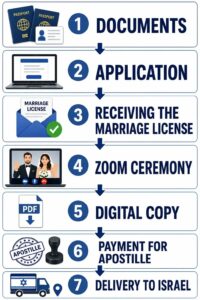
People often ask what actually happens between “I do” on Zoom and holding a certificate. Here’s the honest, unromantic sequence:
- Document review — passports and, if relevant, divorce dates are checked before anything is scheduled. No translation or apostille is needed for a prior divorce decree, in any language — a detail that surprises almost everyone.
- License and ceremony scheduling — a marriage license is issued and is valid for 32 days, so the ceremony date is set within that window.
- The Zoom ceremony itself — typically 15–20 minutes, conducted by an officiant physically located in Utah, with the couple and witnesses joining remotely from wherever they are.
- Certificate issuance — the state processes and issues the official Marriage Certificate.
- Apostille — the certificate is apostilled, which is what makes it automatically recognized as a foreign public document under the Hague Convention, without needing separate legalization.
- Delivery and registration in Israel — the certificate typically reaches the couple within about 30 days of the ceremony; full closure, including updating the Ministry of Interior’s population registry, generally takes 6–8 weeks total.
None of these steps is dramatic on its own. What matters is that each one has an owner and a deadline — which is usually the difference between a smooth process and a stressful one.
The Future of Online Marriage: Why More Couples Continue Choosing Utah Every Year
When online marriage first appeared, many people believed it would be a temporary solution. Three years later, reality tells a very different story.
The number of couples choosing online marriage in Utah continues to grow—not because people cannot travel, but because they no longer see unnecessary travel as essential for a legally recognized civil marriage.
Digital Government Services Are Becoming the New Standard
People renew insurance policies online. They pay taxes electronically. Banks open accounts remotely. Against that background, online marriage no longer feels unusual. The wedding ceremony has not become less meaningful. Only the paperwork has become more convenient.
Why Professional Agencies Will Remain Important
Automation simplifies procedures. It does not replace human guidance. Some couples involve different nationalities. Others require immigration planning. Some need surname changes. Others begin family reunification procedures immediately after marriage — a process handled in Israel by the Population and Immigration Authority.
No automated checklist can fully replace personalized advice based on practical experience.
Looking Beyond the Wedding Day
The ceremony lasts only a short time. Marriage lasts much longer. Future considerations may include: registration in Israel; Apostille documentation; family reunification procedures; surname changes; updating official records; immigration planning; inheritance matters; and questions about National Insurance (Bituach Leumi).
Helping couples understand these future steps has become an increasingly important part of our work. A successful ceremony is only the beginning of the legal journey.
Our Philosophy
At A.R.IMMIGREALTY, we have never believed that our work is simply about arranging online weddings. Our responsibility is much broader. Founder Alexander Binder brings 27 years of legal experience abroad to every case, and the agency itself has been arranging civil marriages since 2019 — the Utah program came later, in 2023, after the Supreme Court ruling opened the door to it. We help people understand unfamiliar legal procedures. We explain complicated administrative requirements in plain language. We identify potential problems before they become expensive. Most importantly, we try to make one of life’s most significant events feel calm rather than stressful.
Final Thoughts
Looking back over the past three years, one conclusion stands above all others. People do not choose online marriage in Utah because they love tradition less. They choose it because they appreciate efficiency, transparency and legal certainty.
Technology has not replaced commitment. It has simply removed many unnecessary obstacles between two people who have already decided to spend their lives together.
For everyone at A.R.IMMIGREALTY, it has been a privilege to help hundreds of couples begin that journey. We look forward to helping many more in the years ahead.
Frequently Asked Questions
How many couples has A.R.IMMIGREALTY helped over the past three years? More than 300 couples from Israel and around the world have completed legally recognized online marriages in Utah with A.R.IMMIGREALTY’s guidance since the program began in March 2023.
Is online marriage in Utah still popular after the pandemic ended? Yes. Demand has continued growing even after international travel returned to normal, because the convenience, legal certainty, and cost advantages remain regardless of travel conditions. In 2024, roughly 5,316 Israelis registered marriages through Utah — the largest single nationality using the program.
Can family members from different countries attend the same ceremony? Yes — some ceremonies have connected relatives from six or more countries simultaneously, something rarely possible with a traditional destination wedding.
What are the most common mistakes that delay an application? Small administrative details cause the most delays: passports expiring soon, inconsistent surname spelling across documents, and incomplete divorce documentation from a previous marriage.
Does A.R.IMMIGREALTY only help with the wedding itself? No. Support typically continues afterward — covering registration in Israel, apostille documentation, surname changes, and long-term matters like inheritance and National Insurance.
How much does the whole process cost? ₪1,980, all-inclusive — agency fee, Utah state fees, and apostille. There are no additional charges added afterward.
How long does it take to receive the actual Marriage Certificate? On average, about 30 days from the Zoom ceremony to receiving the apostilled certificate. Full registration with Israel’s Ministry of Interior typically takes 6–8 weeks in total.
Do we need to translate a previous divorce decree? No. A prior divorce decree can be submitted in any language — no English translation and no apostille are required for it.
Is a separate certificate of no impediment to marriage required? No. Valid passports for both spouses, plus divorce date(s) if applicable, are what’s needed — no separate certificate of marital status.
Can same-sex couples marry through this process? Yes. Same-sex couples are among the regular clients using Utah’s online marriage option, and the resulting marriage is registered in Israel on the same basis as any foreign marriage.
Is this legally recognized in Israel, or just symbolically? It is fully legally recognized. Israel’s registrar records foreign marriages based on the official public document from the country where they were performed, a principle reaffirmed by the Israeli Supreme Court’s 07.03.2023 ruling.
Can non-Jewish couples in Israel use this option? Yes — and it’s worth noting that non-Jews in Israel can also marry through their own religious courts (Christian, Muslim, Druze, etc.). Utah becomes relevant for interfaith couples, those without a recognized religious jurisdiction for their situation, or those who simply prefer a civil process.
Can soldiers on active duty complete the process? Yes — this is one of the more common situations we handle. Ceremonies have been conducted during short leave windows without requiring the soldier to travel abroad at all.
Can tourists temporarily in Israel use this service? Yes. Tourist status in Israel does not prevent a couple from completing an online Utah marriage.
Will the price ever be raised? It hasn’t moved in three years and hundreds of marriages. There’s no planned increase.
How can we verify an agency like this isn’t a scam before paying? Check independent Google reviews, ask which Supreme Court ruling and which Utah statute the agency relies on, confirm the price is quoted as one all-inclusive figure, and ask them to explain the step-by-step process before you commit to anything.
What happens if we change our minds partway through? It happens occasionally — a scheduling conflict, a family situation, cold feet. The process is built to be transparent enough that stepping back doesn’t leave you guessing where things stand.
Contact A.R.IMMIGREALTY
If your situation resembles one of these cases — or if you simply want honest answers before deciding — contact A.R.IMMIGREALTY or call +972-54-215-07-24.
Disclaimer: Case details have been generalized to protect client privacy. This article is provided for general informational purposes only and does not constitute legal advice.
Related Articles
🟩 Weddings Abroad – A.R.IMMIGREALTY 🟩 Wedding in Georgia 🟩 A.R.IMMIGREALTY Homepage – Marriage in Israel