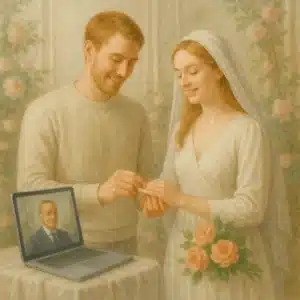






Utah Online Wedding Day: What Actually Happens When You Say “I Do” From Israel
Quick Answer. A Utah online wedding day is short — the ceremony itself runs about 12 to 15 minutes — but the day around it deserves real planning. Utah sits nine to ten hours behind Israel, so most couples in Israel book a morning slot with the Utah County registrar, which lands on a comfortable evening at home. You’ll need valid passports, a laptop, stable internet, and two adult witnesses who can join from anywhere in the world. The apostille, Hebrew translation, and Ministry of Interior registration follow afterward — typically around 30 days total from ceremony to certificate in hand.
Why the Utah Online Wedding Day Deserves Its Own Guide
Most articles about marrying through Utah focus on the legal mechanics — is it recognized, what documents are needed, how much does it cost. What almost nobody explains is the day itself: what a Utah online wedding day actually feels like from the inside, hour by hour, from the moment you wake up to the moment you close the laptop and realize you’re married.
That gap matters. A Utah online wedding day isn’t a courtroom formality squeezed into a lunch break — it’s still a wedding, and the couples we work with tend to remember the day itself far more vividly than any paragraph of Utah Code. Understanding the shape of the day in advance turns it from something abstract and slightly intimidating into something you can actually plan around — except this one changes your legal status by the time it’s over.
If your situation involves a previous marriage or a complicated family history, some of those details affect document preparation well before your Utah online wedding day itself.
Before You Book: Why ₪1,980 Isn’t a Red Flag
We hear the same question almost every week: “If this is real, why is it so cheap?” Fair question — a wedding in Cyprus runs ₪5,000–8,000, so ₪1,980 for a fully legal U.S. marriage understandably makes people pause. Here’s what actually explains the gap, and how to check any of it yourself before paying anyone:
- No flights, no hotels, no notary fees. The entire ceremony happens by Zoom. You’re not paying for anyone’s plane ticket — including ours.
- The certificate and the apostille are both issued by government bodies — Utah County and the U.S. State Department chain, not by us. Counterfeiting either one is a federal matter, not something a low-cost agency could fake even if it wanted to.
- Check us independently before paying anything — our Google reviews, the actual Supreme Court ruling that makes this legal, and Utah’s own state records are all public.
- What happens after you pay: a contract, a scheduled Zoom slot, a test call the evening before, the ceremony itself, then the certificate and apostille by mail. Nothing is “trust us and wait” — every stage has a document attached to it.
- We’re not planning to raise the price. ₪1,980 has covered every stage since we started doing Utah marriages in 2023, and that isn’t changing.
- A low star rating you see somewhere isn’t necessarily from a real client — we ask anyone skeptical to cross-check names against confirmed case dates before assuming a bad review is accurate.
- Before paying any agency for this — not just us — check: is the officiant Utah-licensed, does the contract name an exact price with no hidden add-ons, is the apostille process explained in writing, and can you find the agency’s name in independent press or court filings.
Time Zones: Utah vs. Israel on Your Wedding Day
Utah runs on U.S. Mountain Time. Israel sits nine hours ahead in the winter and ten hours ahead in the summer, because the two countries switch to daylight saving time on different dates.
Almost every couple planning a Utah online wedding day from Israel books the registrar’s morning slot, since it falls on a relaxed evening at home rather than the middle of the night. Double-check the exact offset for your specific date — the switch to daylight saving time doesn’t happen on the same day in both countries, so the gap can shift by an hour for a few weeks each spring and fall.
The Night Before: A Technical Checklist
A Utah online wedding day runs on three things: internet, hardware, and light.
Internet and device. Anything above 10 Mbps handles video reliably. A laptop beats a phone for most couples — the camera usually frames wider, and nobody’s arm gets tired holding a phone up for fifteen minutes straight.
Light and sound. Face a window or a lamp — never sit with your main light source behind you. Headphones with a built-in microphone cut down on echo, especially in rooms with high ceilings or tile floors.
Documents within reach. Both passports need to be physically nearby during the call — the registrar may ask to see them on camera as part of identity verification.
“The most common panic on a Utah online wedding day has nothing to do with the law — it’s the router,” our ceremony coordinator says. “We always tell couples to run a test call on the exact device they’ll use, the evening before.” For the full technical rundown — audio settings, backup connections, what the platform actually looks like — see our Zoom ceremony technical requirements guide.
Who Can Be a Witness on Your Utah Online Wedding Day
Utah County requires two adult witnesses with valid photo ID present for the ceremony. They can be anywhere — a sibling in the next room, a friend on another continent, a colleague in a different time zone entirely.
Couples typically choose one of three setups: a family member and a friend joining from different locations, both witnesses physically present in the same room as the couple, or witnesses supplied by the agency when a couple can’t line up two people with matching availability — a routine option, not a fallback of last resort, and one that’s included in the ₪1,980 price rather than billed separately.
Minute by Minute: Inside the Ceremony
10 minutes before. Everyone connects — the couple, two witnesses, and the Utah County registrar — to a secure video call. The registrar verifies identity against both passports.
Minute 0–2. Welcome, a short explanation of the process, and confirmation that both partners are entering the marriage freely and knowingly.
Minute 2–8. The registrar reads the official legal formula in English. If needed, an interpreter joins to translate in real time — this should be arranged in advance, not improvised on the call.
Minute 8–12. Vows and final confirmation of consent from both partners.
Minute 12–15. The registrar pronounces the couple legally married under the laws of the State of Utah. The call ends.
From that minute forward, the couple is legally married under U.S. law. Getting the paper certificate and apostille afterward is a matter of paperwork catching up — not a condition of the marriage itself.
The Legal Foundation Behind a Utah Online Wedding Day
The legal mechanic that makes all of this work: under Utah law, the marriage is considered to take place where the officiant physically sits — inside Utah — regardless of where the couple happens to be joining from. It’s the same logic as a notary: you can sign a document from your kitchen table, but it’s the notary’s own location that makes the signature legally valid. That’s what makes a Utah online wedding day legally identical to a courthouse ceremony in Salt Lake County, not a workaround or a loophole. The specific provision governing who may solemnize a marriage remotely and how witnesses participate is Utah Code §81-2-305; license validity and timing are covered separately under §81-2-302.
Israel’s Supreme Court ruling of March 2023 — עע”ם 7368/22, Ministry of Interior v. Bril (case file 22073680) — required Misrad HaPnim to register these marriages once presented with a valid foreign certificate bearing an apostille. You can read the ruling itself here — we’d rather you verify it yourself than take our word for it. The apostille itself is issued under the 1961 Hague Apostille Convention, administered internationally by the Hague Conference on Private International Law — it’s less a stamp confirming a document is real, and more the legal bridge that makes a foreign paper mandatory to accept in Israel.
The First Hours After “I Do”
Right after the call. Take a screenshot of the confirmation screen — it isn’t an official document, but it’s a useful safety net while the real paperwork is in transit.
Within 24 hours. Utah County begins preparing the official certificate. Between certificate processing and the apostille that follows it, the average couple has the finished, apostilled document in hand around 30 days after the ceremony — occasionally faster, occasionally slower depending on the county’s workload that month.
Within the first week. Start assembling the packet for Misrad HaPnim: a certified Hebrew translation of the certificate, both partners’ identification, and — if either partner was previously married — a divorce decree (no apostille or translation required for the decree itself). For a full walk-through of what to check on the certificate before it’s apostilled, see our certificate and apostille checklist.
Common Mistakes Couples Make on the Day
Booking a slot without converting time zones properly — double-check the conversion, ideally with the agency’s help. A witness who can’t log in at the last minute — keep a backup on standby until the call actually starts. An expired passport — check both passports’ expiration dates at least a week ahead. Household noise mid-ceremony — pick a room with a door that closes.
Myths About a Utah Online Wedding Day
“It’s not a real marriage, just paperwork.” The Utah County registrar is a licensed government official, and the ceremony follows the same legal requirements as an in-person courthouse wedding.
“Israel doesn’t recognize it.” It does — the March 2023 Supreme Court ruling confirmed it, and the Ministry of Interior is legally required to register the marriage once the apostilled certificate is submitted.
“Witnesses have to be in the room.” Utah law explicitly allows witnesses to join remotely from anywhere in the world.
“Weak English means no ceremony.” Not true — an interpreter can join the call, as long as it’s arranged with the registrar beforehand.
“The marriage shows up on your Israeli ID immediately.” It doesn’t — apostille, translation, and a Misrad HaPnim visit all happen after the ceremony, on their own timeline.
“₪1,980 is too cheap to be a real legal service.” It’s the full price, not a teaser rate — there’s no separate “government fee” invoice waiting after you’ve already committed, which is usually where a genuinely low-cost service turns out to have a catch.
Real Cases From Couples in Israel
Rachel and Marco, Netanya. Rachel is a secular Israeli citizen; Marco is Italian. The rabbinate wasn’t an option for them. Their ceremony started at 7 PM Israel time, from Marco’s apartment — internet cut out for ninety seconds mid-ceremony when a neighbor’s construction crew hit a cable outside, but the registrar simply paused and resumed once the connection came back.
Daniel and Josh, Tel Aviv. Since same-sex marriages aren’t registered inside Israel, the couple chose a Utah online wedding day specifically because Utah law treats every couple the same, regardless of gender. Their witnesses joined from Be’er Sheva and from a hotel room in Bangkok, seven time zones apart.
Miriam and Avi, Modiin. Miriam, an immigrant whose Jewish status wasn’t confirmed by the rabbinate, spent three evenings rehearsing her vows in English before the ceremony. “We were terrified of freezing on camera,” she says. “In the end the registrar was patient, and once even helped with a word we both blanked on.”
Sarah and Yonatan, Ashdod. Sarah, raised secular in the U.S. before making aliyah, and Yonatan, an Israeli citizen with no confirmed halachic status, spent months unsure how to marry at all. Their ceremony happened on a Thursday evening, right after Yonatan finished work — no time off needed, no flights booked. “We kept waiting for it to feel complicated,” Sarah says. “It just didn’t.”
Leon and Priya, Haifa. Leon is Israeli; Priya, a nurse from the Philippines working in elder care, was on a temporary visa with limited flexibility to travel. Their ceremony solved a problem that had stalled their plans for over a year.
Noa and Julien, Ramat Gan. Noa is Jewish; Julien, French and Catholic. Neither the rabbinate nor a church wedding worked for both of them equally — a civil ceremony neutral to both backgrounds, recognized the same way in Israel and, eventually, in France.
🟥 Case: When the Ceremony Almost Didn’t Happen Efrat and Mikhail, Rishon LeZion. Their ceremony was scheduled for 8 PM Israel time — and at 7:45, Mikhail’s laptop update froze mid-installation. “We genuinely thought we’d have to reschedule,” Efrat laughs. “Then I remembered we had a tablet in the drawer.” They joined from a ten-inch screen propped against a stack of books, and the registrar never mentioned the improvised setup once.
Case: Two Witnesses, Three Continents Dana and Chen, Kiryat Ata. Dana’s sister joined from Melbourne; Chen’s college roommate joined from Toronto. Between the couple in Israel and their two witnesses, the ceremony spanned three continents and a fourteen-hour spread of local times. “Somebody was drinking morning coffee, somebody was eating dinner, and we were the only ones actually up late,” Chen says. “It still felt like everyone was in the room.”
Case: A Utah Online Wedding Day With an Unexpected Guest Michal and Ron, Kfar Saba. Midway through their ceremony, the family cat jumped onto the desk and sat directly in front of the camera for almost a full minute. The registrar, unfazed, simply paused the reading of vows until the cat wandered off on its own. “It’s now our favorite part of the video,” Michal says.
Case: Rescheduling Twice Yael and Simon, Nahariya. The couple had to reschedule twice — first because of a family health scare, then because of a scheduling conflict with a witness. “We worried it would feel like a bad omen,” Yael admits. “It wasn’t. Utah County didn’t charge us extra, didn’t ask for an explanation, and the third date finally stuck.”
Case: A Client Who Almost Didn’t Book at All Ilan and Wei, Rehovot. Ilan admits he called three other agencies first and hung up on two of them mid-pitch because the pricing “kept growing every time I asked a follow-up question.” He booked with us specifically because the ₪1,980 figure never changed between the first call and the signed contract. “I actually asked twice if that was really the final number,” he says. “It was annoying how simple the answer was.”
More Real Cases: The Small Details Nobody Warns You About
Omer and Katya, Petah Tikva. Omer’s parents, both in their seventies, had never used Zoom before their son’s ceremony. Katya spent an hour the night before walking her future in-laws through a test call, screen-sharing over the phone to guide them button by button. “By the actual ceremony, my mother-in-law was more comfortable on camera than I was,” Omer jokes.
Alina and Boaz, Herzliya. The couple planned their ceremony around Boaz’s shift schedule at a hospital — the only slot that worked landed at 5 AM Utah time, right after Boaz clocked out of a night shift. “I was exhausted and thrilled at the same time,” he says.
Talia and Andres, Beit Shemesh. Talia is Israeli; Andres, Colombian, was still finishing a work contract in Bogotá when they scheduled the ceremony. He joined from a coworking space at 2 AM local time, wearing a suit jacket over a T-shirt because he’d packed light for a work trip, not a wedding. “Nobody on the call could see below my shoulders,” Andres laughs.
What Comes Next: From Certificate to Registration
Getting the apostilled original is the halfway point of the journey, not the finish line. From there: a certified Hebrew translation, a visit to your local Misrad HaPnim branch, and — for couples where one partner is a foreign national — opening a file under the family reunification procedure.
FAQ
Can we reschedule if something goes wrong right before the ceremony? Yes — Utah County generally allows a reschedule with advance notice.
Do both partners need to be in the same room during the call? No, Utah law allows partners to join from separate locations, even different countries.
What happens if the registrar can’t hear us clearly? The ceremony pauses until the connection is stable enough to continue.
Are guests allowed beyond the two required witnesses? Usually yes, as long as it doesn’t affect the technical quality of the call.
Can we record the ceremony for ourselves? Yes, for personal use — it doesn’t replace the official certificate.
What if a witness doesn’t show up on time? The ceremony is delayed until a replacement connects.
Is there a dress code? No formal requirement, though most couples dress up anyway.
Can we write our own vows instead of the standard formula? Yes, if the wording is approved by the registrar in advance.
What if we only have phones, no laptop? That’s fine — a stand or tripod helps avoid a shaky picture.
Do we need an interpreter during the ceremony itself? Only if English isn’t comfortable for both partners — arrange it beforehand through the agency.
How long does the whole thing take, start to finish? About 12–15 minutes of active ceremony, plus 5–10 minutes for connecting and verification.
Can poor video quality cancel the ceremony? If the picture drops out completely, the call is rescheduled.
Should we call the Ministry of Interior right after the ceremony? No — wait for the apostilled original first, which typically takes around 30 days.
Can the ceremony happen at night, Israel time? Yes, though most couples prefer Utah’s morning slot, which lands on a comfortable evening at home.
Does the time difference stay constant all year? No — different daylight saving dates in Utah and Israel mean the gap can shift by an hour for part of the year.
Do we need to bring anything physical besides our passports? No — passports are the only required physical document during the call itself.
Can our wedding day be postponed if a family emergency comes up? Yes, Utah County generally allows rescheduling with reasonable notice.
Is it different for couples who’ve been married before? The ceremony itself is identical — the only difference is the additional documentation (a divorce decree, no apostille or translation needed) required before approval.
What happens if it falls on a Jewish holiday? Utah’s registrars operate on the U.S. calendar, so Israeli holidays don’t affect scheduling.
Can grandparents who live abroad watch? Yes, though they typically join as a separate side call rather than as part of the official conference.
Does the location we call in from matter legally? No — the marriage is legally considered to take place in Utah, where the registrar is physically located.
Can we change our minds about the date after booking? Yes, up until the ceremony itself — rescheduling is routine and doesn’t involve penalties in most cases.
Is there a maximum number of guests allowed to watch? No fixed limit, though very large calls can strain bandwidth.
Can our ceremony happen if one partner is only fluent in Hebrew? Yes — an interpreter can join to translate in real time, arranged beforehand.
Does it cost more if we need to reschedule? No — Utah County generally doesn’t charge rescheduling fees, and it doesn’t change the ₪1,980 agency price either.
Can pets or children be visible in the background? Yes, there’s no restriction.
What if we need to reschedule more than once? There’s no formal limit.
Conclusion
A Utah online wedding day asks less of you legally than you’d expect, and more of you logistically than you’d guess — a charged laptop, good light, two ready witnesses, and the right math on time zones. The legal groundwork is already settled: Israel’s Supreme Court closed that question back in March 2023. All that’s left is not sleeping through the alarm, and not leaving your passport in the other room.
This material is for informational purposes only and does not constitute legal advice. For guidance on your specific situation, we recommend consulting a specialist directly.
⭐⭐⭐⭐⭐ A.R.IMMIGREALTY Consulting Agency — Israel. ☎ tel:+972542150724 · WhatsApp 24/7 · ec-passport.co.il · Email: abinder1909@gmail.com
📞 If you’re ready to schedule your own Utah online wedding day, or just want to walk through the timeline together first — call tel:+972542150724, available 24/7.
🟩 Related Articles 🟩 Weddings Abroad 🟩 Entry Visa for Spouse or Partner to Israel 🟩 Online Marriage in Utah for Citizens of the Philippines and Thailand
Consulting agency in Israel
A.R.IMMIGREALTY 054-215-07-24 / WhatsApp, abinder1909@gmail.com
Ramat Gan, Herut 34, Israel
Bnei Brak, Metzada 9, Israel